

Tusker House gets underestimated constantly. Guests book it for the characters, eat their fill of curry chicken and POG juice, and walk out thinking they’ve figured the place out.
They haven’t.
The restaurant sitting in Harambe Village is one of the most obsessively researched and carefully constructed spaces in Walt Disney World, and almost none of that work is visible on the surface. That’s precisely the point.
Here’s what’s actually going on in there.
The Walls Were Designed to Look Like They’re Failing
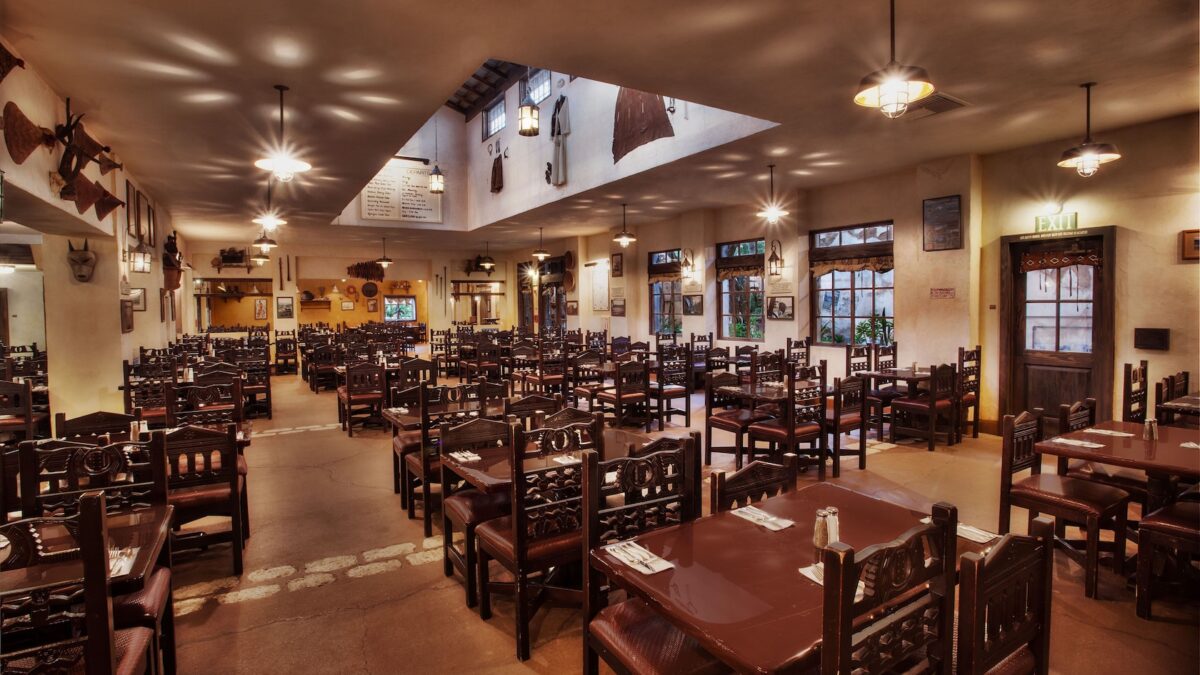
Before construction on Animal Kingdom began, Joe Rohde laid out a philosophy that governed everything built in the park’s lands, including Harambe. In a pre-opening lecture recorded in 1998, Rohde told cast members that Africa, Asia, and DinoLand were all designed to look degraded: weathered, aged, peeling, rotting, “succumbing to the force of nature.”
The cracked stucco on Tusker House isn’t the result of Florida humidity. It was designed that way from the first drawings. The decay is a philosophical statement about nature winning, and it was intentional from day one.
Harambe Isn’t Based on a Real Place. It’s Based on Two.
Rohde has been direct about this. None of Animal Kingdom’s lands were meant to be geographically real. Harambe looks a lot like Lamu in Kenya, but not in a replicative way, and there are substantial stylistic departures.
He’s described it as a smash-up of Lamu, Kenya and Arusha, Tanzania: two mercantile border towns that share the same energy as the fictional village. Disney invented a fictional East African port rather than representing any real community, which gave Imagineers room to build something convincing without being accountable to any specific place. The design team spent a full week in Lamu studying how people live, the architecture, the materials. Not to copy it, but to absorb it well enough to invent something that felt true.
Article Continues Below
The White Walls Aren’t Actually White
According to the Imagineering Field Guide to Disney’s Animal Kingdom, the buildings in Harambe that appear white actually contain a blue tint, replicating a specific practice from Lamu, Kenya, where white pigments are traditionally mixed with laundry bluing to make the color appear brighter.
Nobody notices it consciously. That’s the whole idea. It reads as “more real than expected” without anyone being able to say why.
Every Sign Outside the Restaurant Was Written by a Linguist
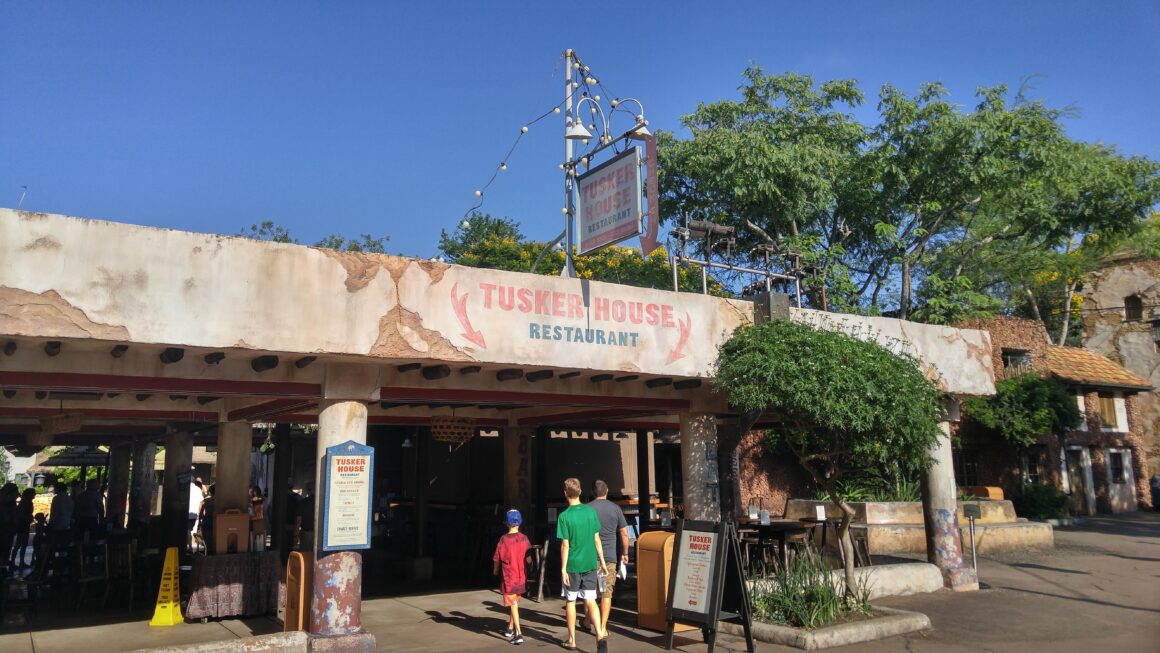
The posters and notices plastered around Tusker House look casually authentic. They are anything but.
Imagineering writer Kevin Brown traveled through Africa collecting print ephemera, including newspapers, pamphlets, posters, and stickers, specifically to study what he described as the “tweaked, third-world Victorian” grammar of Kenyan English. He then worked with a Los Angeles university translator named Sara Mirza to craft precise Swahili and English pairings for every sign in Harambe.
All English text uses British spelling throughout: “Behaviour,” “Way Out” instead of “Exit,” staying true to Kenya’s colonial past. The slightly off layouts and amateurish typography on some signs are also deliberate. Skilled designers intentionally doing bad work to simulate a community printing its own notices without professional help.
One of Those Signs Is a Very Dry Joke
On a wall directly in front of Tusker House, a Swahili inscription translates to: “There is no permission to install livestock in front of this wall.”
It has been there since the park opened in 1998. The percentage of guests who have ever translated it is effectively zero.
The Name on the Building Is Also a Real Beer
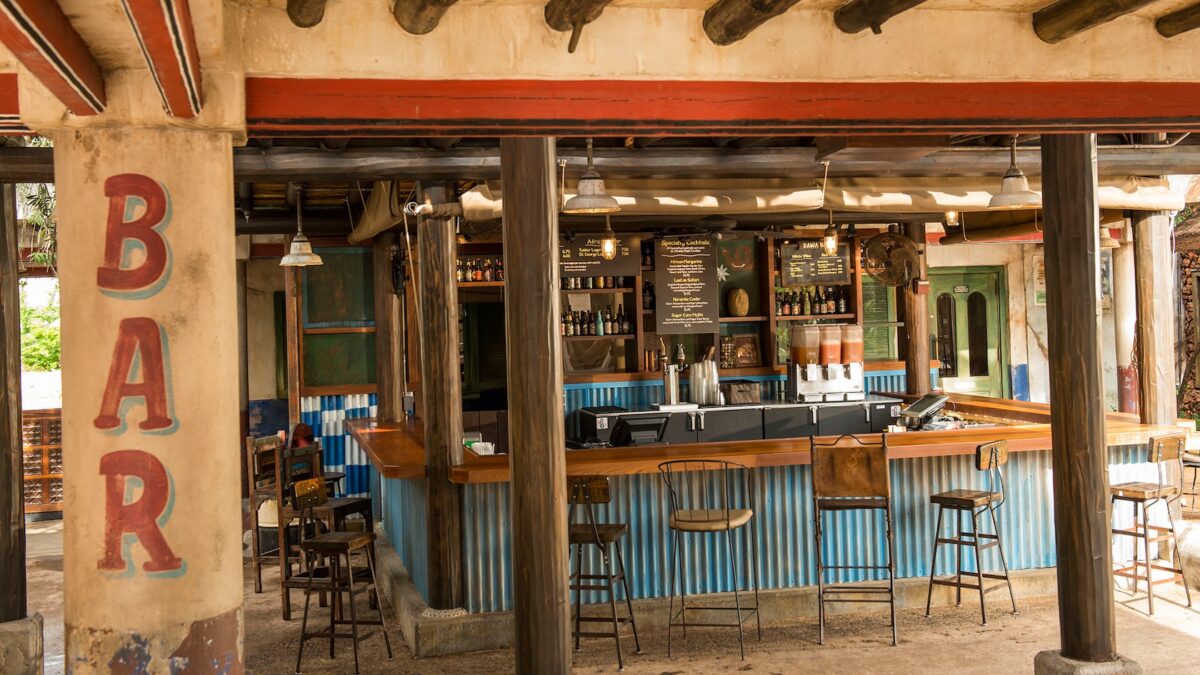
The word “Tusker” isn’t invented. It’s one of Kenya’s most iconic beers, and it’s served at the Dawa Bar just outside the restaurant entrance. The name was chosen deliberately, one more layer of authenticity baked into a building that is full of them.
If you’ve never stopped at the Dawa Bar before your meal, it’s worth knowing it exists. It’s a covered, shaded waiting area, and the Ngumu Jungle Juice is the drink to get.
Joe Rohde Isn’t the Only Imagineer Hiding in the Building
Everyone who knows anything about Animal Kingdom knows about the “Jorodi Masks and Beads” sign, a phonetic nod to Joe Rohde and his famous earring. What most people miss is that the whole fictional streetscape around Tusker House is essentially a staff credits reel.
“Mjafari Architectural Restoration Co.” references architect Ahmad Jafari. “John Ngao’s Artifacts,” where shields are advertised for sale, is a nod to landscape planner John Shields. The Imagineers who built Harambe wrote themselves into it as fictional shopkeepers, and guests walk past them every single day.
Animal Kingdom Has More Signage Than Any Other Disney Park, and Much of It Was Designed to Be Wrong
Disney’s Animal Kingdom contains over 3,200 individual pieces of signage and ephemera, more than any other Disney theme park. A significant portion of what surrounds Tusker House falls into what Rohde calls “ghost graphics”: advertisements and notices applied via faux wheat-pasting, then sealed under clear coat with their rips, tears, and wrinkles intentionally preserved.
One notice in the area explicitly prohibits the posting of advertisements. It is surrounded by advertisements. That’s not an oversight. It’s a joke.
Article Continues Below
The Dining Rooms Were Designed to Each Feel Different
Inside the restaurant, every room has its own distinct atmosphere. The walls are covered in maps of Africa showing growing regions and exports, and the artifacts throughout the space were chosen to tell a story about a working marketplace, not a theme park restaurant.
The characters move through all of it in safari gear, Donald as the host, joined by Mickey, Goofy, and Daisy. During lunch, kids are often invited to join a jungle march through the dining hall with the characters. It is one of those moments that works better than it has any right to.
The Architecture Was Chosen Partly for Crowd Flow
Rohde has explained that Swahili architecture was chosen for Harambe not only for cultural authenticity, but because its rectilinear forms and squarish doorways work better for a dining and retail environment. Wider openings move guests more efficiently.
Even the visual identity of the neighborhood was run through the practical filter of getting thousands of people in and out of a restaurant without creating a bottleneck.
The Entire Africa Concept Came From a Traffic Jam
The insight that crystallized Animal Kingdom’s Africa section came during a research trip to Lake Nakuru in Kenya. The Imagineers heard over the radio that someone had spotted a leopard in a tree. By the time their truck arrived, more than forty vehicles were already crowded around the spot, people hanging out the windows with cameras.
That was the moment Rohde understood what they were actually building. As he put it: “Africa is a theme park, just not a particularly well-run one.” Everything inside Tusker House, the safari orientation center framing, the departure boards, the guide rosters on the whiteboard, descends directly from that traffic jam in Kenya.
So next time you’re waiting on your third plate of peri peri salmon, look up. Look at the walls. Read the signs. Someone spent an enormous amount of effort making all of it feel like nobody tried.