

Fifty years in, Space Mountain still has a four-hour wait on a good day and a chokehold on the collective Disney imagination. Everyone knows it’s dark, it’s fast, it’s Tomorrowland’s white cone. But the real story of how it got there — and what’s hiding inside it — is far stranger, more accidental, and more impressive than the version on the souvenir postcard. Here are seventeen facts that hold up under pressure.
The name was decided by a vote — and “Ski Space Mountain” was a real contender.
Through most of its development, the attraction cycled through “Space Voyage” and “Space Port” before the team at WED Enterprises held an internal vote in 1966 to settle on a name. During the debate, bumper stickers were reportedly printed reading “Ski Space Mountain.” The winning name wasn’t locked in until that vote. Walt Disney had been calling the general concept a “space mountain” informally, but it wasn’t official until employees made it so.
Walt first pitched the idea in 1964. The ride opened in 1975. He died in 1966 and never saw it.
The concept was originally intended as the centerpiece of Disneyland’s 1967 Tomorrowland overhaul. It missed that deadline, was effectively shelved following Walt’s death in December 1966, and didn’t open until eleven years after he first described it to designer John Hench. Space Mountain is, among other things, a decade-long act of posthumous loyalty.
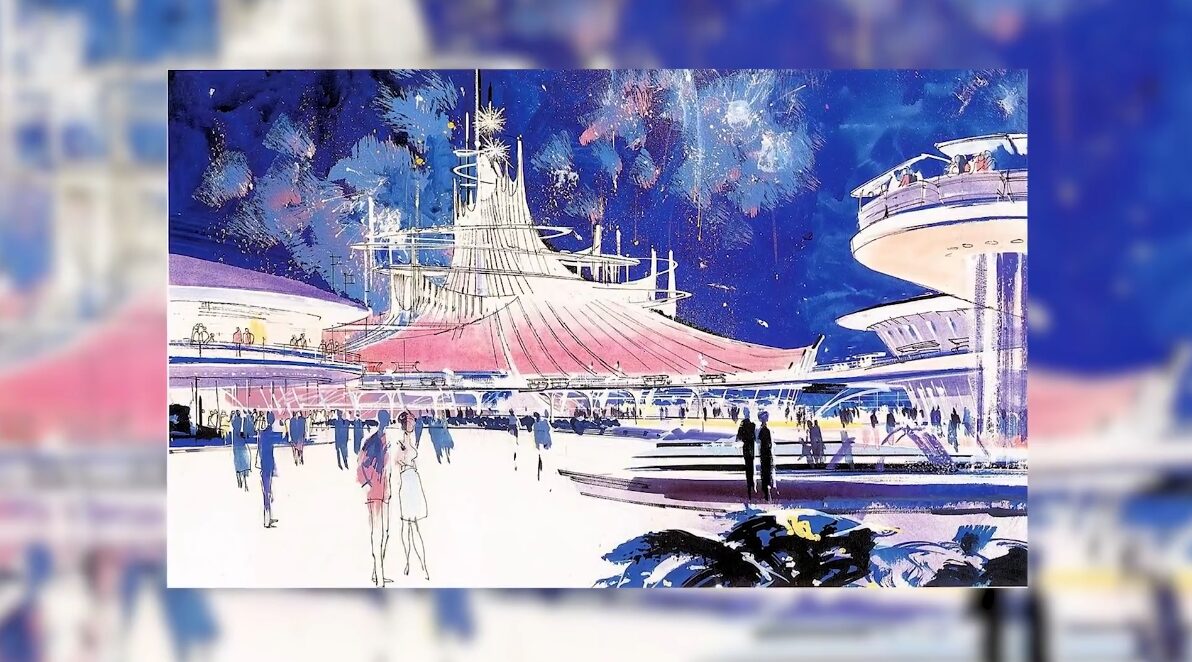
The original design called for four tracks.
Not two. Four separate tracks weaving through the same show building, all running simultaneously. The computing power required to safely manage that many vehicles on a gravity ride simply didn’t exist yet. When the technology finally caught up enough to make the ride buildable, the design had been scaled back to two — which is still unusual enough to be a talking point fifty years later.
Article Continues Below
A single track curve took a full day to compute.
Engineer Bill Watkins accessed a mainframe computer in Omaha via dial-up modem to run the gravity ride calculations. Rendering one curve — just one — consumed an entire day of computing time. The track has dozens of curves. Disney wasn’t being slow; they were literally waiting for Moore’s Law to catch up to John Hench’s 1964 sketches before the ride could physically exist.
There are no boosters, no retarders, and no motors on the track. None.
Watkins fought Disney leadership to build Space Mountain as a pure gravity ride — no “energy wheels” to speed or slow the vehicles between block zones. He described the idea of adding them as “putting ketchup on a steak.” Every block zone is positioned at an elevated section of track, so that if a vehicle is stopped mid-ride, the brakes simply release and the rocket coasts back to the station under its own momentum. No evacuation required.
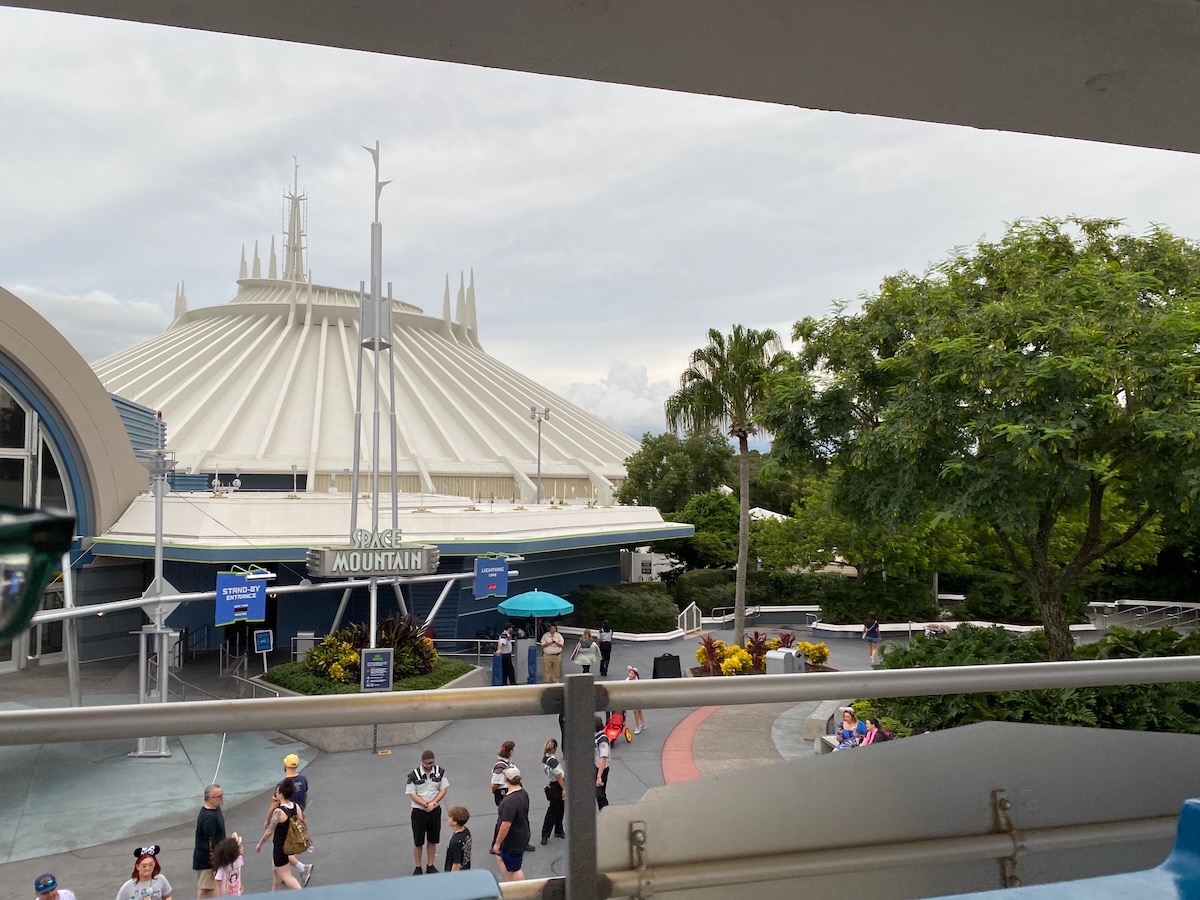
The exterior beams are on the outside on purpose — and for four separate reasons.
In almost any other structure of this type, the support beams would run along the interior. John Hench flipped them to the outside for reasons that stack on each other: the interior walls needed to be smooth and unobstructed so that projected stars, planets, and effects would read clearly against them; the varying beam spacing — narrow at the top, progressively wider toward the base — creates a forced-perspective illusion that makes the 183-foot cone appear significantly taller than it is; the exterior grid gives the structure a visual language that deliberately echoes the Contemporary Resort, which was designed four years earlier as part of the same Tomorrowland skyline concept; and the spiral geometry of the beams mirrors the spiral geometry of the track inside. Hench later said it was his favorite architectural project of his career.
The building is outside the park.
Magic Kingdom’s Space Mountain doesn’t technically sit within the park’s boundaries. The structure is so large it couldn’t fit inside Tomorrowland, so Imagineers built it beyond the Walt Disney World Railroad berm. Guests reach it through an underground passage called the “star corridor.” This is also why the Tomorrowland Transit Authority PeopleMover can thread through the building’s interior — it’s passing through what is essentially an adjacent structure, not cutting through the middle of a land. Disney officials also deliberately built the cone shorter than originally planned, specifically to avoid visually competing with Cinderella Castle from across the park.
Article Continues Below
Half the construction cost came from a contract clause.
The $20 million price tag was extraordinary — more than the entire original cost of building Disneyland in 1955, which came in at $17 million. To make the numbers work, Disney CEO Card Walker went back to an existing infrastructure contract. RCA had already been hired to build the communications systems for Walt Disney World, and buried in that agreement was a clause: if Disney ever pitched RCA an attraction they found compelling enough to sponsor, RCA was contractually obligated to contribute $10 million toward it. Walker pitched Space Mountain. RCA said yes. Half the ride was effectively pre-funded before a shovel hit the ground.
The man who took the first official ride had walked on the Moon.
The dedication ceremony on January 15, 1975 featured a 2,000-piece marching band, daytime fireworks, and a prime-time NBC television special. Apollo 15 astronaut Colonel Jim Irwin — one of twelve human beings who had stood on the lunar surface and looked out at actual mountains in space — climbed into a rocket and took the inaugural run. He had been to the real thing. Disney gave him the first ticket anyway.
The opening post-show featured Kurt Russell singing a bubblegum pop song on a laserdisc player.
RCA used the exit walkway to showcase its latest consumer technology in an elaborate attraction called “Home of Future Living.” Among the exhibits was a laserdisc home video system — itself a brand-new format in 1975 — playing a clip of a young Kurt Russell covering “Sugar, Sugar” by The Archies, pulled from a Wonderful World of Disney broadcast. RCA was demonstrating the future of home entertainment. The future of home entertainment was a teenager singing a 1969 pop song in what was essentially a theme park commercial. Russell had also recorded the song for a Capitol Records album. It is very 1975.
RCA’s mascot dog is still on the ride. He just had a quiet career change.
Nipper — the iconic fox terrier from RCA’s “His Master’s Voice” branding — was placed at the Space Mountain entrance in a flying saucer, listening to a gramophone in space. When RCA’s 18-year sponsorship ended in 1993, nobody removed Nipper. Instead, Imagineers quietly retrofitted him with robotic detailing and reclassified him as a generic space robot. He’s been there ever since, unacknowledged, no longer on anyone’s payroll.
Article Continues Below
The exit corridor is a graveyard for dead attractions.
A sign in the post-show exit labeled “Closed Sectors” lists defunct Magic Kingdom attractions by their former land and location. The roll call includes 20,000 Leagues Under the Sea in Fantasyland, Mr. Toad’s Wild Ride in Fantasyland, Skyway to Fantasyland in Tomorrowland, Mission to Mars in Tomorrowland, and several others. It reads as an in-universe decommission notice. It is also a quietly devastating piece of Disney park history for anyone who knows what those names meant.
A piece of baggage in the exit is addressed to a city that never existed.
The post-show baggage claim area — themed as an intergalactic spaceport — includes a suitcase stamped “Mesa Verde.” This isn’t a real place. It’s the name of a fictional underwater settlement from EPCOT’s Horizons, the beloved pavilion that closed in 1999 and was never replaced. It’s one of several Horizons tributes folded into the 2009 refurbishment, alongside a post-show diorama deliberately labeled “20,000 Lightyears Under the Sea” — a triple reference to Jules Verne, the defunct Magic Kingdom submarine ride, and Horizons’ own underwater sequence.
The exit spaceship has a signature hidden in plain sight.
The vessel visible near the end of the exit corridor is marked “H-NCH (SM1975)” — a coded reference to John Hench, the Imagineer who shepherded the project from Walt’s original 1964 concept sketch all the way through the 1975 opening. He didn’t put his full name on it. Just enough letters to be found by someone looking.
The rocket nozzles were Krylon spray paint caps.
Imagineer George McGinnis was building the scale model for the ride’s interior spaceship and needed placeholder nozzles for the rocket engines. He grabbed some Krylon spray paint caps off a shelf — liked the shape, moved on. Later, someone pointed out that the flared geometry of those caps is actually aerodynamically correct for ion engines. The caps were reproduced at full scale in the finished attraction and have been there ever since. McGinnis later wrote that it makes him smile every time he walks past them.
Article Continues Below
The Tomorrowland Transit Authority PeopleMover is the only way to see the ride with the lights on — if you time it right.
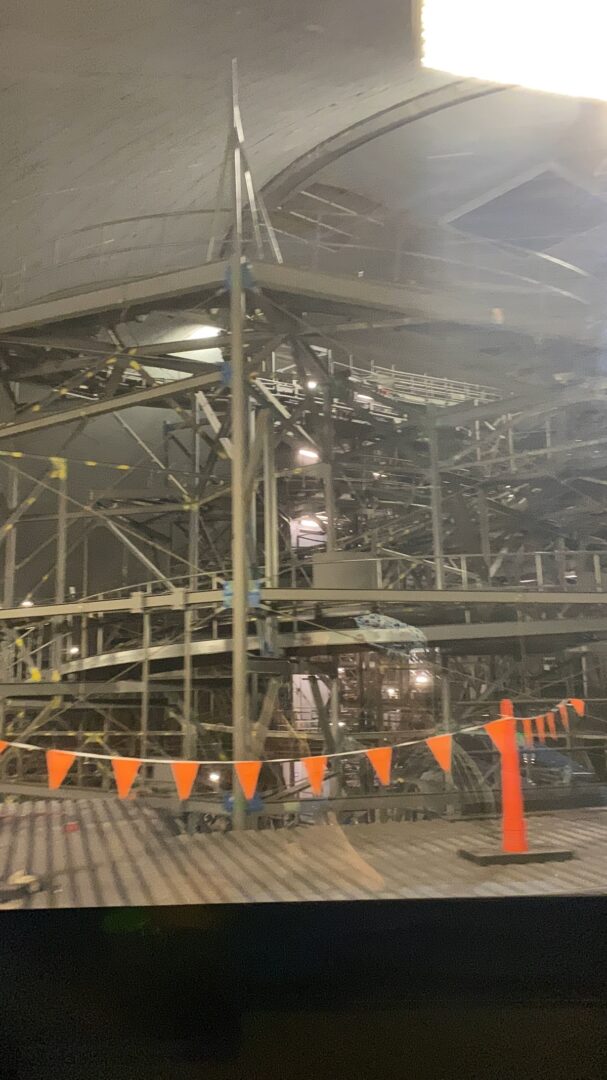
When Space Mountain goes down for a technical stop, the work lights inside the dome come on. The PeopleMover, which passes through the building’s interior on a separate elevated track, continues operating during those stoppages. Guests on the PeopleMover can look down and see the full coaster layout illuminated — the tracks, the rockets staged in their block zones, the ceiling infrastructure that disappears entirely in normal operation. It’s an accidental backstage tour that happens at random and can’t be planned for.
The Tokyo replacement opening in 2027 will be the most expensive Disney attraction ever built — and the original cost more than all of Disneyland.
When the WDW Space Mountain opened in 1975, its $20 million price tag exceeded the $17 million it cost to build the entirety of Disneyland in 1955. That gap felt enormous at the time. Now, Oriental Land Company’s quarterly financial filings confirm that the new Space Mountain rising at Tokyo Disneyland — scheduled for a 2027 opening — is budgeted at ¥70.5 billion, roughly $460 million USD, making it the most expensive single attraction Walt Disney Imagineering has ever built. The name circulating in construction reports is Space Mountain: Earthrise. Whatever it ends up being called, the ride that started as a napkin sketch in 1964 is now, sixty-three years later, still setting records.