

There’s a moment that happens to almost every first-time visitor to Magic Kingdom. You walk through the tunnel under the train station, step onto Main Street USA, and the castle appears at the end of the street looking impossibly large and impossibly far away — like something out of a painting.
It isn’t an accident. And the castle isn’t as tall as it looks.
What you’re experiencing is forced perspective — one of the oldest tricks in architecture, used by Disney with a precision that borders on obsessive.
What Is Forced Perspective?
Forced perspective is a technique that manipulates the size of objects to make them appear larger, smaller, closer, or further away than they actually are. It works by exploiting the way human eyes interpret scale and distance — when objects get progressively smaller as they recede from view, our brains read that as depth.
Disney’s Imagineers didn’t invent it. Renaissance painters used it. Hollywood used it for decades on film sets. Disney creative director John Hench was one of the first to formally connect theme park design to filmmaking — noting that the same visual techniques that make a movie set convincing work just as powerfully on physical architecture that guests walk through. Disney took that insight further than anyone.
Cinderella Castle: The Most Famous Example

Cinderella Castle stands 189 feet tall — and that number is not an accident either. Florida law requires any building over 200 feet to be fitted with red aviation warning lights. Disney wasn’t about to put blinking red lights on top of Cinderella Castle, so the Imagineers stopped at 189 feet and used forced perspective to make it feel like something far more towering.
Every level of the castle is built at a progressively smaller scale as it rises. The base is close to full scale. The middle sections compress slightly. The upper spires are built at roughly one-quarter of their apparent size — the bricks get smaller, the windows shrink, the architectural details tighten. Your brain reads all of that compression as height and distance and fills in the rest.
There’s one more layer to it. Tinker Bell isn’t illuminated during her nightly flight until she moves away from the castle — because lighting her near the spires would reveal their true scale. And the topmost spire is almost never fully lit, allowing it to blend into the sky and appear to continue upward indefinitely. The illusion is being maintained even after dark.
Main Street USA: The Trick You Walk Through Every Visit

The castle gets most of the attention, but Main Street USA is where forced perspective works hardest. The ground floors are built at roughly full scale. The second floors are built at about 75 percent scale. Third floors, where they exist, are smaller still — scaled so tightly that no full-sized adult could actually stand in them.
This does two things simultaneously. It makes the buildings feel grander than they are. And it makes the street feel longer — which makes the castle at the far end appear more distant and more dramatic when you finally reach it.
Here’s a detail most guests never notice: Main Street is also built on a slight incline, rising gently toward the castle. The rooflines angle upward as you walk. Combined with the compressed upper floors, your eye is being drawn along a series of converging lines that all point directly at the castle entrance. You’re being guided emotionally down that street by architecture alone.
Not every building on Main Street uses forced perspective, though. The Town Square Exposition Hall and Tony’s Town Square restaurant are both built at closer to full scale — specifically because they needed to be tall enough to block the view of the Contemporary Resort from inside the park. Disney was not going to let a modern hotel tower interrupt the turn-of-the-century streetscape, and two full-height buildings solve that problem completely.

Article Continues Below
The EPCOT Eiffel Tower Nobody Talks About
Forced perspective extends well beyond Magic Kingdom. The Eiffel Tower standing behind the France pavilion at EPCOT’s World Showcase is built from the original blueprints of the real structure — scaled down to one-fourteenth size. The Imagineers then used forced perspective and careful sightlines to make it read as full-sized and simply far away. Most guests glance at it, register “Eiffel Tower,” and move on without ever questioning the scale.
Beast’s Castle in Fantasyland is another example — a relatively small structure perched on top of the much larger building that houses Be Our Guest restaurant. From ground level, with nothing real-world nearby to compare it against, it reads as a castle on a distant hill. It works because there’s no fixed reference point to break the illusion.
Which brings us to the one thing that breaks every illusion Disney has ever built.
When the Real World Breaks Everything
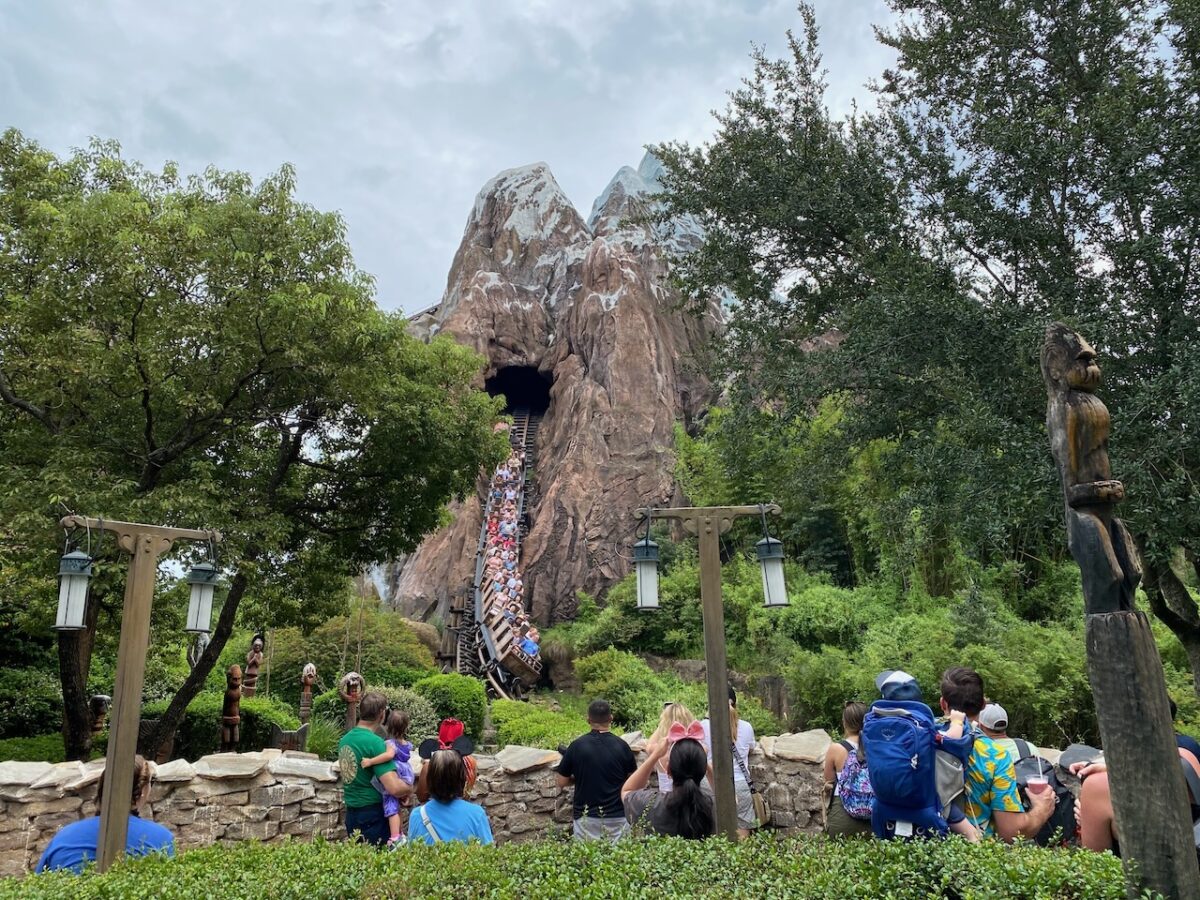
The most jarring thing you can experience at a Disney park isn’t a long wait or a ride breakdown. It’s a real-world object appearing somewhere that forced perspective has carefully controlled.
A seagull lands on a Main Street rooftop. Suddenly the building is completely the wrong size. The bird is enormous relative to the upper floor — because that floor was never meant to be compared against something with fixed, real-world dimensions. Your brain recalibrates in an instant. The illusion collapses. For just a moment, Main Street USA looks exactly like what it is: an extraordinarily clever movie set.
It’s jarring because it shows you how completely Disney had fooled you up until that moment — and how much invisible work is being done every second you’re in the park just to keep everything feeling right.
Forced perspective is everywhere at Disney World. You walk through it, photograph through it, and experience the parks entirely through its lens. Most guests never notice it once. But once you do, you start seeing it everywhere — and the parks become a completely different place to visit.
Article Continues Below
Why It Matters Beyond the Trick
Forced perspective isn’t a construction shortcut or a visual gimmick. It’s a storytelling tool. Disney uses it to make guests feel small in the presence of something grand — which is exactly the emotional state that makes a theme park feel magical rather than manufactured.
When you feel genuinely dwarfed by Cinderella Castle, that feeling is real even if the scale isn’t. That’s the whole point.