

Most guests walk through the Haunted Mansion queue and admire the tombstones without realizing they’re looking at a Hall of Fame. Every name carved in those stones belongs to a real person — a designer, animator, sculptor, songwriter, or special effects wizard who poured years of their life into building one of the most beloved attractions in theme park history.
This is their story.
What Is an Imagineer?
Before we meet them, a quick note. Walt Disney didn’t call his theme park designers “engineers” or “designers.” He coined the term Imagineer — a portmanteau of imagination and engineer — because the job required both in equal measure. The original Imagineers were mostly animators and artists first, people Walt trusted because he knew they could draw, build worlds, and tell stories. He simply asked them to do it in three dimensions instead of two.
The Haunted Mansion brought together some of the greatest Imagineers who ever worked at Disney. Their creative disagreements, compromises, and obsessions are baked into every scene of the attraction. When you ride it, you’re experiencing the result of years of argument, experimentation, and genius.

Walt Disney — W.E.D.
His tombstone reads: W.E.D. — Walter Elias Disney
We start at the beginning, with the man on the hillside. Walt’s tombstone in the queue is understated — just his initials and his full name. No flourish, no epitaph. Fitting for someone whose presence permeates the entire attraction without ever being loudly announced.
Walt’s initials, W.E.D., were also the name of the original Imagineering company — WED Enterprises, named after himself — which later became Walt Disney Imagineering. He founded it in 1952, three years before Disneyland opened, specifically to design and build theme park attractions.
Walt’s contribution to the Haunted Mansion is complicated. He had strong opinions about what it should and shouldn’t be — insisting the exterior be beautiful and well-maintained while the horror lived inside, and famously decreeing “the ghosts can take care of the inside, but we will take care of the outside.” But he passed away in December 1966 before the attraction ever opened, leaving his Imagineers to finish the work without him. The mansion that opened at Disneyland in 1969 — and at Magic Kingdom in 1971 — was completed in his memory, by people who loved him deeply and wanted to get it right.
Harper Goff — The Man Walt Met Over a Train Set
His nod: The Spectrocom device in the interactive queue is patented to “R.H. Goff”
Harper Goff’s origin story is one of Disney’s best. Walt met him in a London model shop, where both men were bidding — aggressively and expensively — on the same model train set. Walt, delighted that anyone else in the world was as obsessed with trains as he was, struck up a conversation and offered Goff a job.
Goff’s background was in Hollywood set design and art direction, including the iconic Jules Verne film 20,000 Leagues Under the Sea. That experience in building immersive physical worlds translated beautifully to Disneyland, and Goff became one of the park’s earliest and most important creative contributors.
For the Haunted Mansion, Goff collaborated with Ken Anderson on the very first concept drawings — a full decade before the attraction would open. Their original vision was a genuinely dilapidated haunted house: boarded-up windows, rotting shutters, a wreck of a building. Walt rejected it immediately. The compromise that followed — a beautiful, well-maintained exterior hiding horrors within — became one of the defining principles of the entire attraction.
Goff’s name is hidden in the interactive queue on the Spectrocom device used to communicate with the mansion’s resident poet, Prudence. Patented to R.H. Goff. Blink and you’ll miss it.
Ken Anderson — The Villain Man
His tombstone reads: “Drink a toast to our friend Ken. Fill your glass and don’t say when.”
Ken Anderson was an animator before he was an Imagineer, and his specialty was villains. Cruella de Vil. Shere Khan. The Evil Queen in Snow White. If you needed someone to conceive something dark and menacing, Ken Anderson was your man.
He was one of the first Imagineers Walt tapped for the Haunted Mansion project, and his animator’s instincts — an eye for character, for staging, for what makes something feel threatening — shaped the attraction’s early DNA. His original concept drawings imagined a haunted house in the most traditional sense of the phrase: decayed, forbidding, and obviously dangerous.
Walt’s rejection of that vision didn’t diminish Anderson’s contribution. The creative tension between his instinct for menace and Walt’s insistence on beauty is part of what makes the final attraction so compelling. The mansion looks like somewhere you’d want to visit. What’s inside is Ken Anderson’s territory.
Article Continues Below
Claude Coats — The Man Who Made It Scary
His tombstone reads: “Claude Coats — beloved friend” (near the mansion entrance)
Claude Coats was a background painter and art director, known throughout his Disney career for a darker, more atmospheric sensibility than many of his colleagues. He believed the Haunted Mansion should be genuinely frightening — not funny, not whimsical, not weird. Scary.
His half of the attraction is the first half. The foyer with the ghost host. The library with its watching busts. The endless hallway. The knocking doors. The portrait corridor. Everything that makes first-time guests grip the side of their Doom Buggy is Claude Coats.
His influence is also felt in a specific detail: the bending, bulging doors in the corridor were directly inspired by the 1963 horror film The Haunting, which Coats cited as a major creative reference. He knew what genuinely unsettling looked like, and he brought it to Liberty Square.
The Art of Deception and The Deception of Art — the painted books in the library attributed to “Claude Coats” — are the Imagineers’ in-joke tribute to a man who spent his career creating beautiful illusions in service of a good scare.
Marc Davis — The Ladies’ Man Who Made It Funny
His tombstone reads: “Grandpa Marc — a good sport”
Marc Davis is one of the most important animators in Disney history, and the reason the Haunted Mansion makes you laugh as often as it makes you shudder.
Before joining Imagineering, Davis was known as the “Ladies’ Man” — not for any personal reasons, but because he was the animator behind Disney’s most iconic female characters. Tinker Bell. Maleficent. Cinderella. Aurora. He had an extraordinary gift for character and expression, particularly in women. When he transitioned to Imagineering, he brought that same gift for character — and added a streak of comedy that became his signature.
Davis believed the Haunted Mansion should be fun. He fought for a whimsical, gag-filled experience rather than a purely terrifying one. His vision is the second half of the ride: the graveyard, the singing ghosts, the swinging wake of happy haunts having the time of their afterlives. The opera singer ghost who is a visual gag on “it ain’t over till the fat lady sings.” The mummy enjoying a tea party. The ghost hanging from the chandelier in the ballroom, oblivious to the party below.
Any time you laugh on the Haunted Mansion, it’s almost certainly Marc Davis.
His chess obsession also left a mark on the building itself. The chess pieces on the mansion’s roofline — king, queen, rook, bishop, pawn, but no knight — are there because fellow Imagineers pranked Davis by stealing pieces from a model and placing them on top. He liked it and kept them, but removed the knight himself. Because it’s always knight in the Haunted Mansion.
Article Continues Below
Rolly Crump — The Eccentric Genius
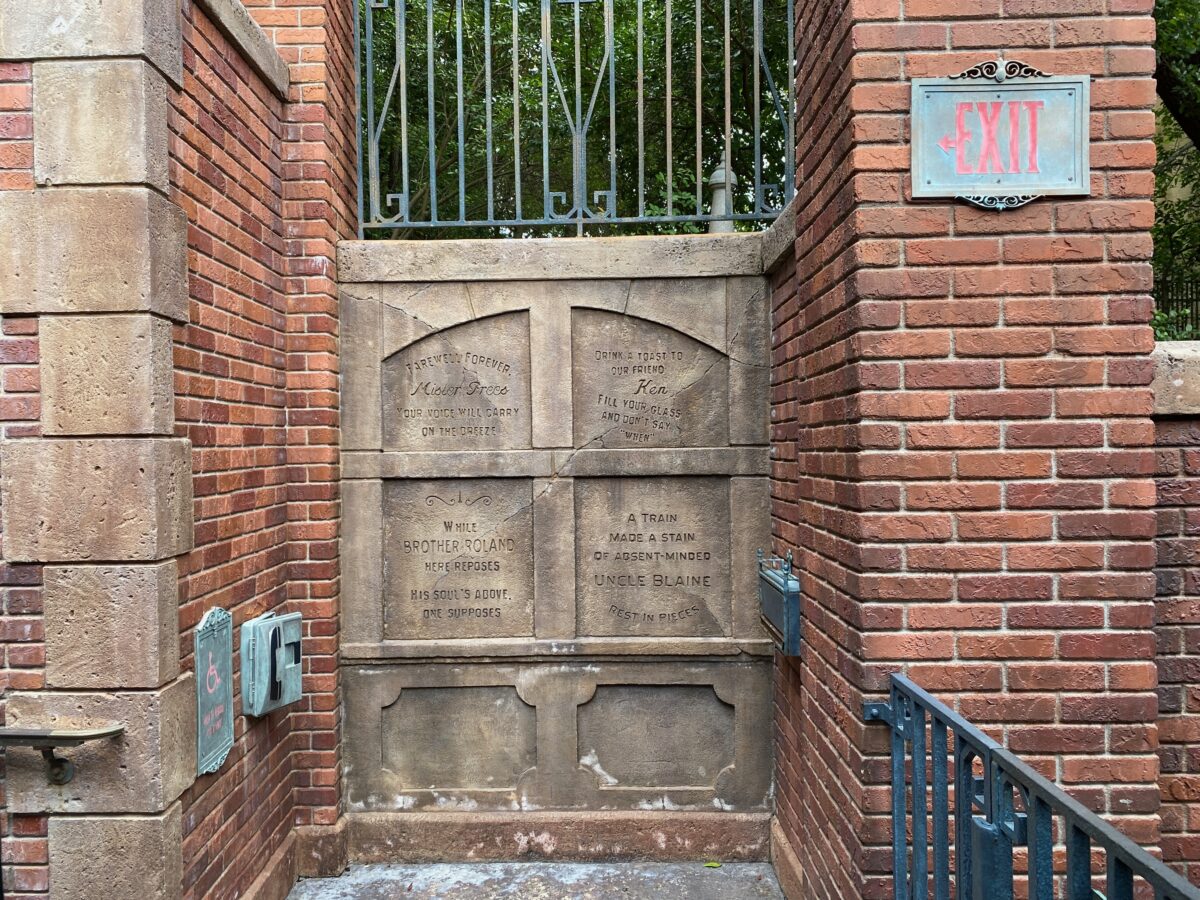
His tombstone reads: “Brother Roland — cut down in his prime”
Rolly Crump was, by his own admission, the strangest of the three lead designers fighting for the soul of the Haunted Mansion — and that’s saying something given the competition.
Where Claude Coats wanted scary and Marc Davis wanted funny, Crump wanted weird. His vision was the Museum of the Weird — an attraction full of unsettling, eccentric, deeply uncanny objects and creatures that weren’t traditionally frightening so much as deeply, fundamentally off-putting. Clocks with fingers instead of hands. Candelabras made of melted human figures. A one-eyed cat. A raven watching your every move.
The Museum of the Weird was never built as its own attraction. But Rolly Crump’s fingerprints are all over the Haunted Mansion if you know what to look for. The Godfather clock with fingers for hands — that’s Crump. The concept art drawings visible on the crypt walls in the queue — Crump. The raven in the queue who was originally meant to be a narrator character guiding guests through the mansion — Crump. The one-eyed cat figure — Crump.
After Crump passed away a few years ago, the Imagineers added a small figure of his Candleman — a character made of dripping, melted wax — directly into the attic scene, taken from his original concept art. It’s one of the most touching tributes in the attraction. Look for it in the attic. The candle holder version of the character also appears in Memento Mori, the gift shop.
His concept art also shows up in the Behind the Attraction episode about the Haunted Mansion on Disney+ if you want to see how close the final product came to his original strange vision.
Yale Gracey — The Magician Who Built the Magic
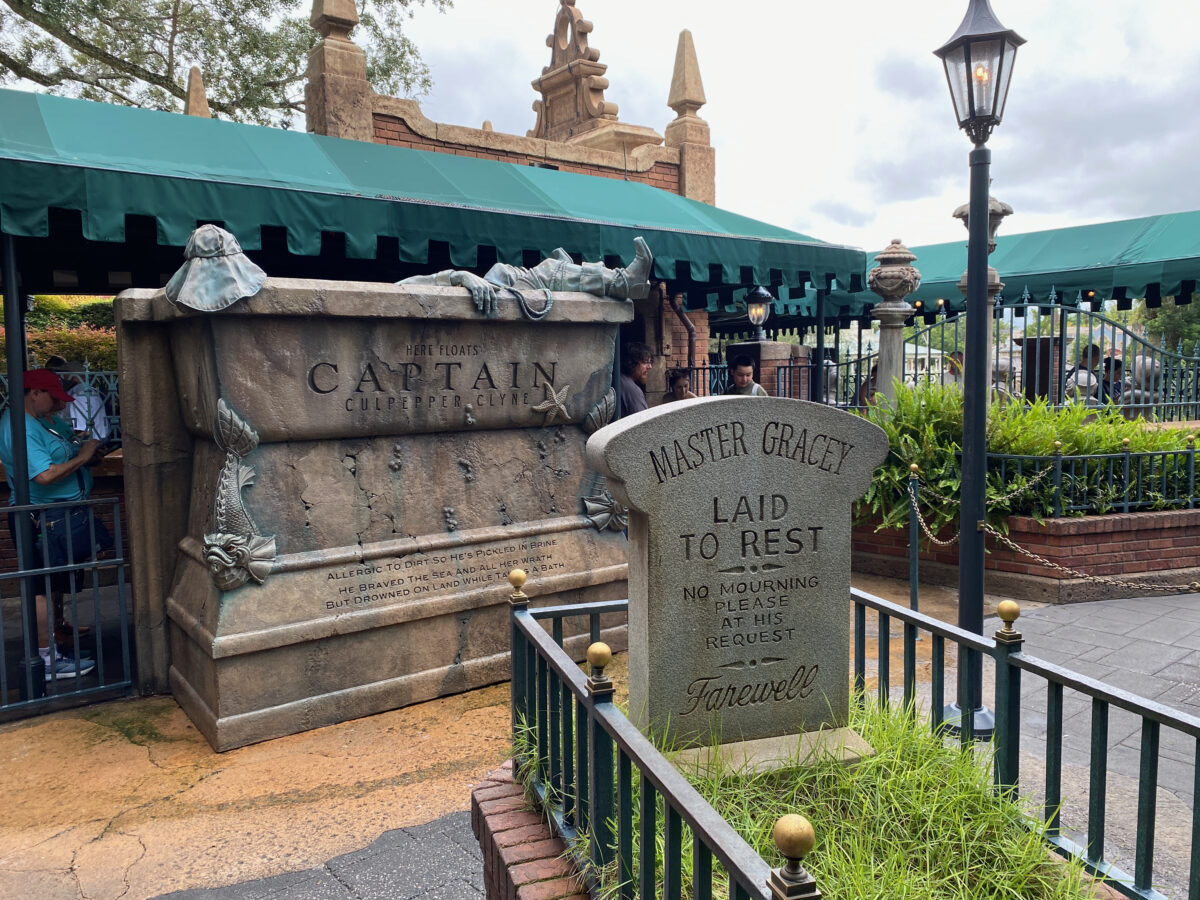
His tombstone reads: “Master Gracey, laid to rest. No mourning please, at his request.”
If one person deserves the most credit for what makes the Haunted Mansion feel genuinely magical, it’s Yale Gracey. He was largely self-taught, had no formal technical training, and was an amateur magician in his spare time. That last part turned out to be the most important qualification of all.
Gracey was the special effects mastermind of the attraction. Working primarily with Rolly Crump, he figured out nearly every iconic illusion in the ride — and the genius of his work is how simple most of it actually is. The library busts that follow you with their eyes? Concave sculpting and a pinpoint light. The ballroom full of dancing ghosts? A Victorian parlor trick called Pepper’s Ghost, scaled to architectural proportions. Madame Leota’s floating head? Projection mapping, invented right there in the workshop.
When the Imagineers first showed the ballroom scene to professional magicians and asked them to explain it, they couldn’t. They didn’t believe glass panels that large existed. Yale Gracey had figured out how to get them airlifted through the roof one by one.
His perfectionism is also the reason the Hatbox Ghost disappeared after a week — the ambient light in the attic was ruining the effect, and Gracey refused to leave something broken in the attraction. He would rather have no Hatbox Ghost than a bad one. Given the subsequent 50 years of legend that built up around that decision, it was arguably the right call.
He was so beloved by the Imagineers who followed him that Daniel Joseph — the man who finally restored the Hatbox Ghost in 2015 — cited Gracey as the reason he became an Imagineer in the first place.
The character of Master Gracey, owner of the mansion, bears his name as tribute. The aging portrait in the foyer is his house. The whole attraction is his legacy.
X Atencio — The Writer Who Never Wrote Before
His tombstone reads: “Francis Xavier — no time off for good behavior”
Francis Xavier Atencio went by X — partly for convenience, partly because it suited his personality. He was an animator at Disney for years before Walt pulled him aside one day and told him he’d be writing the script and songs for a new attraction.
X had never written a song in his life. He told Walt this. Walt told him that was fine, he thought he could do it.
The result: X Atencio wrote the Ghost Host’s entire narration — including “Your cadaverous pallor portrays an aura of foreboding”, one of the most delightfully overwrought sentences in Disney history. He wrote the lyrics to Grim Grinning Ghosts. And, apparently on a roll, he also wrote Yo Ho (A Pirate’s Life for Me) for Pirates of the Caribbean.
The music for Grim Grinning Ghosts was composed by Buddy Baker, a man with over 200 Disney credits to his name — including the Mickey Mouse Club march and the Wonderful World of Color theme. Baker and Atencio together created the sonic identity of the Haunted Mansion: one song, played in continuous variation from the moment you enter the foyer to the moment you leave, evolving from a funeral dirge on the organ to the swinging graveyard anthem you’ll be humming for the rest of the day.
X also voiced the coffin scene himself. That frantic “Let me out! Let me out!” you hear as you pass? That’s X Atencio, the man who wrote the Ghost Host’s eloquent narration, screaming to escape a box. The Imagineers had a sense of humor about their own work.
Article Continues Below
Blaine Gibson — The Sculptor of the Haunted Mansion (and Almost Everything Else)
His tombstone reads: “Uncle Blaine — death, be not proud”
Blaine Gibson started at Disney as an animator, but Walt discovered his real gift one day when he noticed the small sculptures Gibson had been making in his woodshop at home. Walt transferred him to Imagineering immediately.
The scope of Gibson’s contribution to Disney history is almost impossible to overstate. He sculpted every ghost in the Haunted Mansion. Every pirate in Pirates of the Caribbean. Every president through George H.W. Bush in the Hall of Presidents. And that’s just the beginning of a list that runs to dozens of attractions across multiple parks.
His method was unusual: Gibson preferred to sculpt real faces he’d observed in the world rather than invent them from imagination. He believed real faces had a truth to them that purely invented ones couldn’t replicate. The result is that somewhere out there, real people are immortalized as ghosts, pirates, and presidents in Disney parks — completely unaware.
His wife had to regularly nudge him in church for staring too long at other parishioners’ faces. The price of sitting next to a genius.
This also means that if you spend enough time with the faces in the Haunted Mansion — the ballroom ghosts, the graveyard singers, the busts in the load area — you might be looking at someone Blaine Gibson once passed on the street.
Harriet Burns — The First
Her tombstone: Sometimes obscured by construction, but present in the queue
Harriet Burns deserves more recognition than she typically receives. She was one of the first three Imagineers ever hired — and the first woman.
Burns came to Disney from television set design and scenic painting, including work on the Mickey Mouse Club. Walt recruited her specifically because of her extraordinary attention to detail, the kind that most people would never notice but that elevated everything it touched. She was a master of the small things — texture, finish, authenticity.
Her most famous specific contribution to Disney lore: she sewed real human hair onto the leg of a pirate at Pirates of the Caribbean. Because a painted leg wouldn’t look right and Harriet Burns would not settle for that.
Her work on the Haunted Mansion included detail and finish work throughout — the kind of contribution that doesn’t have one iconic scene attached to it, but without which the entire attraction would feel less real. The Haunted Mansion is full of surfaces that look exactly right in ways that are hard to articulate. That’s Harriet Burns.
Her bat in the queue is named in her honor by Mansion Maids who know their history.
Fred Jorger — The Rock Star of Imagineering
His tombstone reads: “Here lies Fred. A great big rock fell on his head.”
The tombstone pun is a tribute to Fred Jorger’s nickname within Imagineering: the Rock Star. Not for any musical reason, but because Jorger was Disney’s master of rockwork — the stone walls, boulders, cavern textures, and geological features that make attractions feel physically grounded in a real place.
His credits include the Jungle Cruise and the original fountain in the lobby of the Polynesian Resort. At the Haunted Mansion, his work is in the foundations and stonework that give the exterior and queue their sense of age and weight. Good rockwork is invisible — you feel it as authenticity without knowing why. That’s the goal, and that was Fred Jorger’s gift.
Article Continues Below
Bud Martin — The Spartan
His tombstone reads: “Here lies a man named Martin. The lights went out on this old Spartan.”
Bud Martin was a special effects Imagineer who contributed to the technical wizardry throughout the attraction. The tombstone’s “Spartan” reference is a nod to his beloved Michigan State Spartans — a small personal detail that the Imagineers thought worthy of immortalizing in stone.
It’s one of the things that makes the tombstone section of the queue so quietly moving when you understand it: these aren’t generic names. They’re specific people, remembered with specific details. Bud Martin loved his football team. That made it into the Haunted Mansion.
Sam McKim — The Map Maker
His tribute: A bell in the servants’ quarters, accessible through the chicken exit bypass
Sam McKim isn’t in the main queue tombstones — his tribute is hidden in the servants’ quarters, the secret area accessible to guests who bypass the stretch room through the staff entrance. A bell board lines the wall, each bell labeled with both a mansion location and an Imagineer’s name. One of them belongs to McKim.
McKim started his career as a child actor before transitioning to storyboard artistry and eventually becoming one of Disney’s most celebrated illustrators. He is probably best known today for drawing the original Disneyland park maps — those extraordinarily detailed bird’s-eye view illustrations that became collector’s items and shaped how generations of guests visualized and navigated the park before they arrived.
His bell in the servants’ quarters is easy to miss. Most guests never set foot in that space. But for those who do, knowing Sam McKim’s name is on that board — the man who drew the map that showed guests how to find the Haunted Mansion in the first place — is a genuinely lovely detail.
Leota Tombs — The Face of the Franchise
Her tombstone: The most iconic in the queue, with eyes that follow you as you walk past
We’ve covered Leota Tombs in detail in the characters guide, but she belongs here too — because she wasn’t just a model. She was an Imagineer.
Tombs worked at WED Enterprises as part of the team developing the attraction’s effects. When Rolly Crump and Yale Gracey needed a face for the séance crystal ball effect, she was right there — a striking, expressive woman with the kind of face the camera (or projector) loved. She agreed to model, endured the painstaking process of holding perfectly still in ghost makeup for the recording sessions, and became the most recognizable face in Haunted Mansion history.
With a name like Leota Tombs, the Imagineers would have been mad not to put her in a graveyard. Her tombstone has the eyes that follow you as you walk past — a small, perfect tribute to a woman whose eyes have been following guests through a crystal ball for over 50 years.
Article Continues Below
The Legacy
What strikes you, once you know all of this, is how personal the Haunted Mansion is. Every tombstone in the queue is a specific human being with a specific story. Every effect in the ride is the result of a specific argument, a specific breakthrough, a specific late night in a workshop. The attraction isn’t just a collection of spooky scenes — it’s a portrait of a group of extraordinarily creative people who cared deeply about getting it right.
Marc Davis and Claude Coats fought over whether it should be funny or scary. Yale Gracey and Rolly Crump built illusions that stumped professional magicians. X Atencio wrote a song having never written one before and produced something that has outlasted almost everything else from its era. Harriet Burns sewed real human hair onto a pirate’s leg because the painted version wasn’t good enough.
That level of care is why the Haunted Mansion still works. It’s why effects built in the 1960s still dazzle guests today. It’s why there are tombstones in the queue with real names on them, and why those names matter.
Next time you’re in the queue, take a moment. Read the stones. Say the names out loud if you want. These are the people who built something that has brought joy, wonder, and a healthy amount of screaming to millions of guests for more than half a century.
They deserve to be remembered.
Which Imagineer’s story surprised you most? Tell us @StepsToMagic — and for more Haunted Mansion deep dives, check out our full fun facts guide and character breakdown.