

There’s something eerily comforting about hearing the phrase “Welcome, foolish mortals” as you step into the world of the Haunted Mansion. If you’re anything like us at Steps To Magic, you probably have a piece of clothing showcasing your admiration for this classic Walt Disney World attraction. Get ready to uncover some spine-tingling secrets and fun facts about the home of the Doombuggies.
Read on… if you dare!
The Basics: What You Need to Know
- Area: Liberty Square
- Opening Date: October 1st, 1971
- Attraction Type: Omnimover Dark Ride
- Vehicle Type: Doom Buggy
- Duration: 5:50 – 8:20 minutes
- Lightning Lane: Available
The History (It’s Wilder Than You Think)

1. Walt Disney met one of the mansion’s key designers over a model train set. Harper Goff became a Disney Imagineer after Walt spotted him bidding on the same model train in a London shop. Walt, impressed that anyone else would spend that kind of money on a train, offered him a job on the spot. Goff’s background in Hollywood set design — including 20,000 Leagues Under the Sea — made him a perfect fit for Disneyland’s world-building.
2. Ken Anderson, the man behind the first concept art, was Disney’s villain king. Before working on the Haunted Mansion, Ken Anderson animated Cruella de Vil, Shere Khan, and the witch in Snow White. If you need someone to sketch a haunted house, that’s your guy.
3. Their first designs were too scary — for Walt. When Anderson and Goff showed Walt their original concept art — boarded-up windows, shutters falling off, a full dilapidated wreck — Walt said no. He wanted Disneyland to be immaculate, nothing like the seedy carnivals he grew up visiting. His now-legendary rule: “The ghosts can take care of the inside, but we will take care of the outside.”
4. Three Imagineers fought over the soul of the ride. The mansion’s interior became a creative tug-of-war between three very different visions:
- Claude Coats wanted it genuinely terrifying — dark, brooding, atmospheric
- Marc Davis wanted it funny and whimsical — full of visual gags and playful ghosts
- Rolly Crump wanted it weird and eccentric — odd creatures, unsettling designs, clocks with fingers instead of hands
The genius decision? Use all three. The first half of the ride — the ghost host, the library, the creeping dread — is pure Claude Coats. The graveyard, with its swinging wake of happy haunts, is Marc Davis. Rolly Crump’s fingerprints are on the stranger details throughout. The structure is even intentional: if younger guests get scared in the Coats section, they’ll recover during the Davis half and leave happy.
5. The Doom Buggy was designed by Bob Gurr — the same legendary Imagineer behind the Disneyland Monorail and the Autopia cars. The Omnimover system it rides on was inspired by the Ford Magic Skyway attraction at the 1964 World’s Fair, where guests rode in hollowed-out Ford convertibles through a series of scenes. Disney loved it because the vehicle controls exactly where you look — which is why there’s nothing decorated behind you in the ballroom scene. You’ll never see it.
6. Walt Disney World’s Haunted Mansion was technically finished before Disneyland’s. When the Imagineers built everything for Disneyland’s 1969 opening of the attraction, they built two of everything — two of every animatronic, two of every portrait, two of every prop — knowing Magic Kingdom needed it all for opening day on October 1st, 1971.
7. The Magic Kingdom exterior is based on a real building in Pennsylvania. Disneyland’s mansion is a Southern Plantation manor befitting New Orleans Square. But Magic Kingdom has Liberty Square — colonial New England — so a plantation home would be all wrong. The Imagineers drew inspiration from the Harry Packer Mansion in Jim Thorpe, Pennsylvania, giving Magic Kingdom its distinctive Gothic Hudson Valley look.
8. The Haunted Mansion is the only Disney attraction that sits in a different themed land at every park in the world. New Orleans Square at Disneyland. Liberty Square at Magic Kingdom. Fantasyland at Tokyo Disneyland. An entirely reimagined Phantom Manor at Disneyland Paris. Mystic Manor at Hong Kong Disneyland. Even the Disney Cruise Line themed their version — the Haunted Mansion Parlor aboard the Disney Treasure — to a nautical sea captain. The theme always fits the location.
Article Continues Below
Secrets in the Queue
9. Cast members at the Haunted Mansion aren’t called cast members — they’re Mansion Maids and Butlers. And each one names their decorative bat. Ask them what their bat’s name is. You might hear “Neil Batrick Scaris,” “Bat Benatar,” or “Victor” (for Victor Frankenstein). Their creativity will not disappoint.
10. The hearse out front is a Hollywood film prop. The horse-drawn hearse parked outside the mansion is a recycled prop from the 1965 John Wayne film The Sons of Katie Elder. Look down near it and you’ll spot wagon wheel tracks and horseshoe imprints in the pavement — left by the ghost horse who supposedly pulls it.
11. The covered entrance was period-accurate, not just practical. That black awning over the queue entrance isn’t just Imagineering keeping guests out of the Florida sun. Wealthy estates of the mansion’s era always had a covered carriage drop-off so ladies in their restrictive, floor-length, heavily corseted gowns could enter gracefully without being caught in bad weather. The uncovered entrance nearby was for fair weather and the gentlemen.
12. The mansion is designed to look like a crouching creature. Look at the silhouette from outside. The extended wings on either side aren’t just architectural detail — the whole building is meant to resemble something crouching and ready to pounce. And if you look at the grates, fencing, and ornamental details on the facade, you’ll find bat faces and ghostly figures staring back at you. The feeling that something is watching you starts before you’ve heard a single note of Grim Grinning Ghosts.
13. The chess pieces on the roofline are missing the knight — on purpose. Marc Davis was a passionate chess player. Legend has it his fellow Imagineers pranked him by stealing his chess pieces from a model and placing them on top of the mansion. He loved it and kept them — but removed the knight himself. Because it’s always knight in the Haunted Mansion.
14. The landscaping team chose blood-red roses deliberately. Bill Evans, the Imagineering horticulture master who created a jungle out of orange groves for the original Jungle Cruise, handpicked the Haunted Mansion’s plants. The trees are intentionally large and looming. The roses are blood red. And while the rest of Liberty Square bursts with red, white, and blue flowers, the mansion’s grounds are deliberately muted — because cheerful hydrangeas in front of a haunted house would just be weird.
15. The family portrait busts in the queue are actually a murder mystery. Most guests admire them without realizing there’s a full whodunit buried in the plaques. Here’s the solution: Uncle Jacob was poisoned for his money. Birdie was shot by Aunt Florence. The twins Wellington and Vercynthia got matching bumps on their heads. And Cousin Maud? She forgot to blow out a match before tucking it in her hair (a common Victorian odor trick), took a nap, and set herself on fire. The Imagineers hid the clue on the back of her portrait’s head. If you don’t believe us, go look.
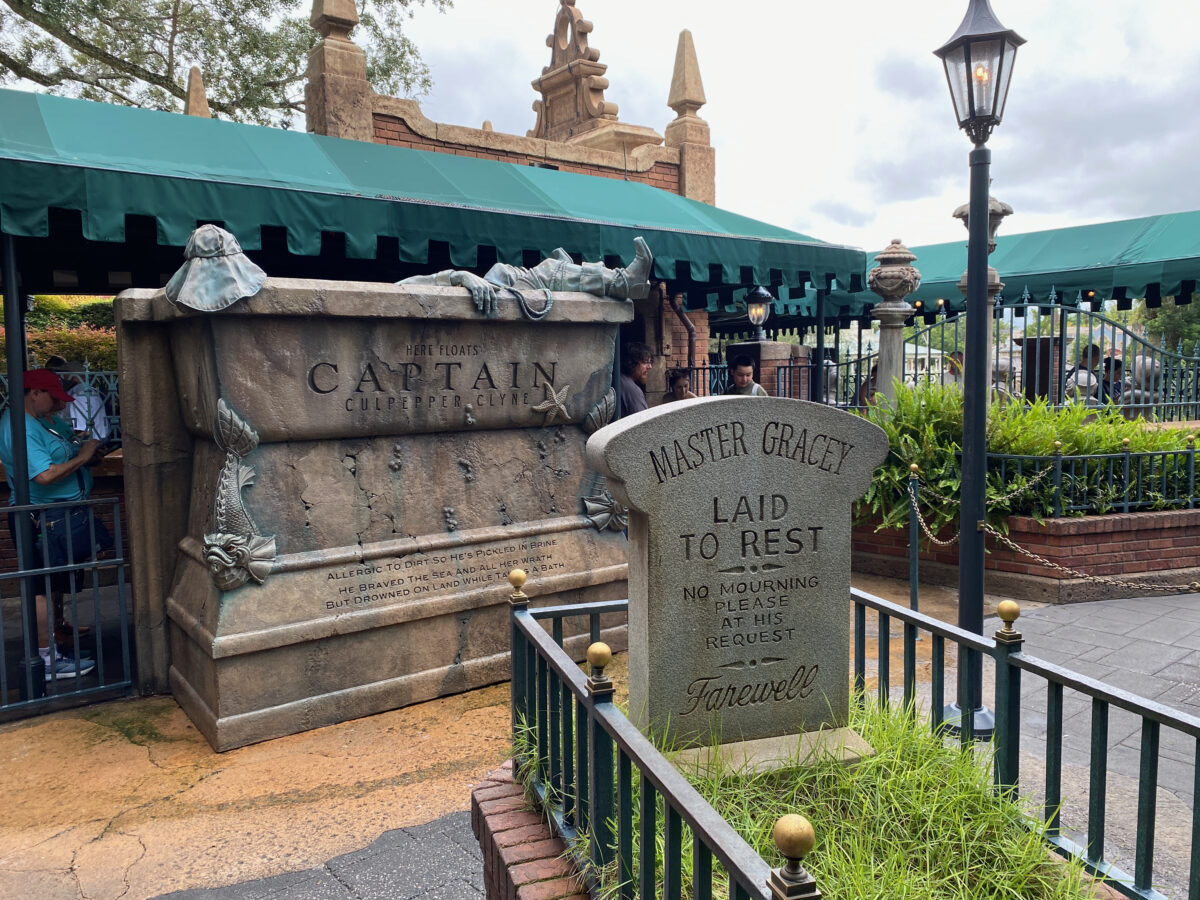
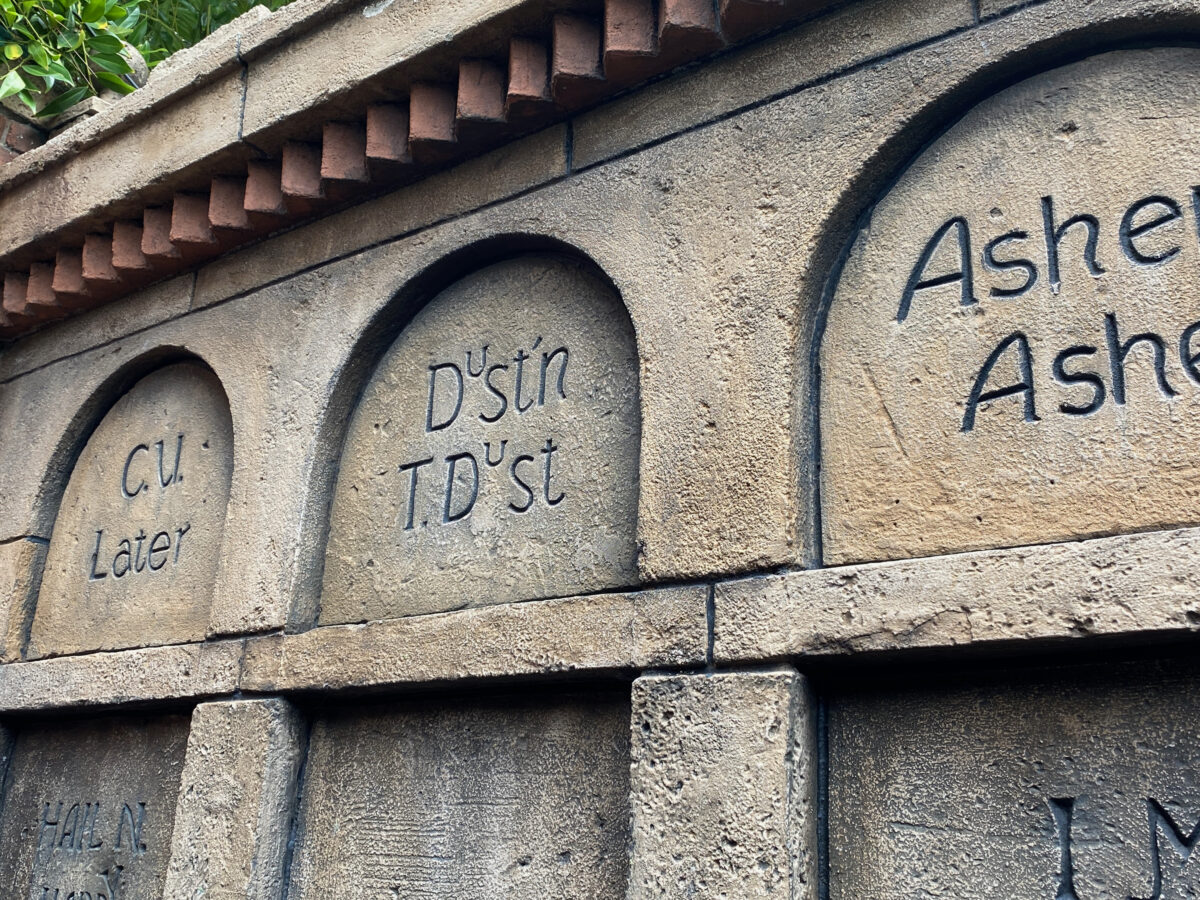
16. The tombstones in the queue are a Hall of Fame for the people who built the ride. Every name on those graves is a real Imagineer. A few highlights:
- Grandpa Marc = Marc Davis, the funny half of the mansion’s soul
- Francis Xavier = X Atencio, who wrote the Ghost Host’s narration, the lyrics to Grim Grinning Ghosts, AND Yo Ho (A Pirate’s Life for Me) — despite never having written a song before Walt asked him to
- Master Gracie = Yale Gracie, the self-taught special effects genius responsible for the ballroom scene, the library busts, and Madame Leota. He’s also the owner of the house — you can see his portrait aging in the foyer
- Uncle Blaine = Blaine Gibson, Walt’s master sculptor, who sculpted every ghost in the mansion, every pirate in Pirates of the Caribbean, and every president through George H.W. Bush in the Hall of Presidents. He sculpted real faces he observed in public — his wife had to nudge him in church for staring at people too long
- Brother Roland = Rolly Crump, the eccentric Museum of the Weird designer
- W.E.D. = Walter Elias Disney himself, up on the hillside
17. The Leota tombstone honors a real Imagineer named Leota Tombs. With a surname like that, her presence in the Haunted Mansion was basically destiny. She served as the face model for Madame Leota — and the tombstone’s eyes follow you as you walk past.
18. Harriet Burns was one of the first three Imagineers ever hired — and the first woman. She came from TV set design (including the Mickey Mouse Club) and was recruited by Walt for her extraordinary attention to detail. She’s the one who sewed real human hair onto a pirate’s leg at Pirates of the Caribbean. She has a tombstone in the queue too, though construction sometimes blocks it.
Article Continues Below
Inside the Mansion

19. The wallpaper in the stretch room is vertical stripes on purpose. It’s period-accurate for the mansion’s era, yes — but vertical stripes also enhance the psychological sensation of the room stretching upward. Every detail is doing double duty.
20. At Magic Kingdom, the stretch room actually stretches. At Disneyland, it’s an elevator. Disneyland needed to move guests underground to access the show building behind the park’s train tracks. In Florida, there’s no such constraint — but they kept the stretch room anyway because it’s iconic. Since they can’t tunnel in Florida (the water table would flood everything), the WDW ceiling actually rises. Watch the gargoyle candelabras from start to finish — they genuinely move.
21. If you linger after the stretch room doors open, the gargoyles will whisper at you. One of them will tell you to get out. To hear it, position yourself as far from the ballerina portrait as possible — that’s where the exit door opens, so you’ll be last to leave. Don’t block traffic, but if you can hang back a few seconds, it’s worth it.
22. Constance the attic bride is foreshadowed in the stretch room. Look carefully at the four portrait paintings as the room stretches. One shows an old woman sitting on a gravestone marked “George” — with a hatchet in his head and a strand of pearls around her neck. That’s Constance. Everything you’re about to learn about her is right there, hiding in plain sight.
23. The Ghost Host’s voice belongs to Paul Frees — and his face is in the stretch room too. Frees was one of the most prolific voice actors of his era, also voicing Ludwig von Drake and the Auctioneer in Pirates of the Caribbean. His likeness was used for the bowler hat man in one of the stretch room’s four painted portraits. Now you know who you’re looking for.
24. The library busts aren’t moving. You are. Those busts that seem to follow you with their eyes are sculpted inversely — concave, pressed into the wall — and lit with a pinpoint light from the neck up. Because you’re moving past them and they’re not, the lighting tricks your brain into perceiving motion. Simple, cheap, and brilliant.
25. The books in the library are painted on the wall. They’re not real books — Disney animators painted them directly onto the surface. Look for The Art of Deception and The Deception of Art, both credited to author “Claude Coats.” A quiet in-joke buried in the scenery for the sharp-eyed.
26. There’s a Donald Duck chair in the library. The pattern on the wingback chair genuinely resembles Donald’s hat, eyes, and bill. Whether intentional or not is a matter of delightful debate.
27. The bending doors in the hallway were inspired by a horror film. Claude Coats cited the 1963 film The Haunting as a direct influence on the mansion’s scariest corridor moments.
28. The knight in the hallway used to be a real person — until a guest punched them. At Disneyland, the original effect used an actual cast member inside the armor. A terrified guest punched the knight in the face, hitting the person inside. The animatronic replacement followed shortly after.
29. “Let me out!” from the coffin was recorded by X Atencio himself. The same man who wrote the Ghost Host’s narration and the lyrics to Grim Grinning Ghosts also recorded his own frantic exit plea for the coffin scene. He voiced it personally.
30. You can see the Ghost Host’s actual portrait inside the ride. Since he’s haunting the mansion, he had to get there somehow. Look for his portrait on the right-hand side as you travel backward through the corridor — he has a noose around his neck and an axe nearby. Connect those dots to the stretch room ceiling and the story writes itself.
31. The staircase to nowhere was inspired by a real building. The Winchester Mystery House in San Jose, California is a real estate where Sarah Winchester — believing ghosts haunted her home — hired construction crews to build continuously, thinking the noise would keep spirits away. They eventually ran out of real projects and started building staircases that went nowhere. It’s now a popular tourist attraction and reportedly very haunted.
Article Continues Below
Madame Leota and the Séance
32. Madame Leota’s face belongs to a real Imagineer — but her voice belongs to Disney’s greatest villain actress. Leota Tombs modeled for the face (with a name like that, her destiny was sealed). Her real voice was too high-pitched and playful for the séance scene, so the Imagineers hired Eleanor Audley — the voice of both Maleficent and Lady Tremaine — to provide the incantations. Once you know that, you’ll never unhear it.
33. The original Madame Leota pioneered projection mapping. Leota Tombs wore ghost makeup in front of a black background, held perfectly still, and mouthed the lines. The Imagineers projected her recorded face onto a casting of her likeness — the very first use of projection mapping technology in history. Over time they developed a miniaturized internal projector, which is why she can now fly freely around the room.
34. She is one of the most protected objects in Magic Kingdom. Staff will stop the ride immediately if anything threatens Madame Leota. Do not test this.
Article Continues Below
The Ballroom Scene
35. When the Haunted Mansion first opened, Disney brought in professional magicians to figure out the ballroom effect. They couldn’t. The answer is Pepper’s Ghost — a technique named for British scientist John Henry Pepper, who popularized it in 1862 during a Christmas Eve performance of a Charles Dickens story. The audience thought they were seeing a real ghost. The technique is elegant in its simplicity: light, glass, and reflection. You’ve seen it yourself if you’ve ever been in a lit room at night and caught a ghostly reflection in a dark window.
36. The ghosts in the ballroom are real animatronics above and below you. A light shines on them, and their reflections appear through massive panes of glass running floor-to-ceiling across the front of the ballroom. The room appears open, but it’s divided by glass — panels so enormous they had to be airlifted in through the roof one by one, with decorative columns installed afterward to hide the seams.
37. The ballroom glass has only been broken once — and not at Magic Kingdom. At Disneyland, a young guest decided to duel his favorite ballroom ghost with a BB gun. The cracks were covered with decorative spiders for years before the panel was finally replaced. Magic Kingdom’s glass has remained intact.
38. The grandmother rocking in the ballroom is the same face as the grandmother in Carousel of Progress. Blaine Gibson sculpted one face — and Disney reused it. The birthday ghost makes the same expression as a famous pirate in Pirates of the Caribbean. Same principle. One sculptor, many haunts.
39. The ballroom dancers’ women are leading the men — because you’re seeing a reflection. The dresses they wear were cut from the same patterns as early Disneyland princess and performer costumes, just aged and darkened to suit the occasion.
Article Continues Below
The Attic and the Hatbox Ghost
40. Constance gains a new strand of pearls with every husband she loses. As you pass through the attic wedding scenes, watch the portraits carefully. Each husband’s head disappears as you move forward, and Constance accumulates pearls. By the time you see her, she’s wearing all five strands and holding a hatchet. Any bride-and-groom figurines in the scene have lost their groom’s head. The champagne flute on his side is knocked over. She is not subtle.
41. The Hatbox Ghost was removed after about one week — and restored 50 years later. Yale Gracie’s original effect would make the ghost’s head teleport between his body and his hat box. The problem: more ambient light bled into the attic than expected, making both images visible simultaneously. Gracie, a perfectionist, had him pulled immediately. The Hatbox Ghost became legend — appearing in promotional materials for years after his removal, with cast members spinning their own lore about him. It wasn’t until 2015 that an Imagineer named Daniel Joseph — who cited Yale Gracie as his inspiration for becoming an Imagineer — solved the effect in his own garage and debuted the restored ghost at Disneyland. He arrived at Magic Kingdom a few years later. His current placement before the séance rather than in the attic sparked debate. The official Imagineering answer: “He’s the Hatbox Ghost. He does what he wants.”
Article Continues Below
The Graveyard
42. The singing bust with the mustache is NOT Walt Disney. This is one of the most common misconceptions in all of Walt Disney World — Guest Services regularly handles complaints from guests who believe the attraction is dishonoring Walt with a broken, knocked-over statue. It’s not Walt. It’s Thurl Ravenscroft — the voice of Tony the Tiger and the man who sang “You’re a Mean One, Mr. Grinch” — serving as lead vocalist for the Phantom Five ghost band.
43. The graveyard ghosts are gold-colored on purpose. The Imagineers experimented with numerous colors and materials before landing on gold, which worked best with the scrim netting and UV lighting to achieve the perfect ghostly glow. The scrim itself — a fine netting in front of the animatronics — gives them their hazy, incorporeal quality.
44. The opera singer ghost is a 19th-century opera reference. Marc Davis designed her as a visual gag on the phrase “it ain’t over till the fat lady sings,” which derives from the final aria of Richard Wagner’s Götterdämmerung — traditionally sung by a heavy-set soprano. Davis turned a 19th-century opera reference into a graveyard punchline. Very on brand.
45. The hitchhiking ghosts can tell how many people are in your Doom Buggy. The modern effect counts your party size — one, two, or three riders — and the ghost’s behavior varies accordingly. And according to Haunted Mansion tradition: Gus (short, bearded) means a great day ahead. Phineas (medium, hunched, covered in travel stickers from Hong Kong and Anaheim) means a fine day. Ezra (tall, skeletal, deeply unsettling) means brace yourself.
Article Continues Below
The Exit and Beyond
46. Little Leota at the exit uses Leota Tombs’ real voice. Unlike the grand Madame Leota in the séance room — voiced by Eleanor Audley — the tiny face urging you to “hurry back” speaks in Tombs’ actual high-pitched voice. The contrast is charming once you notice it.
47. The cobwebs are made with a hot glue gun — and you helped. A device resembling a Ghostbusters backpack sprays a stringy hot-glue substance around the attraction, and then natural things — dust, hair, skin cells — cling to it over time. When a cobweb gets too heavy, they replace it. Which means every visit you’ve made to the Haunted Mansion has contributed to its décor. You’re welcome.
48. Please do not scatter ashes in the Haunted Mansion. This has happened. Multiple times. Disney has a specialized industrial vacuum for exactly this purpose. Rather than your loved one resting peacefully among 999 happy haunts, they will be collected by a machine and disposed of as a biohazard. It is not the tribute anyone deserves.
49. There’s a secret chicken exit that bypasses the stretch room entirely. If someone in your party can’t handle the enclosed space, ask a Mansion Maid or Butler quietly. They can guide you through the servants’ quarters — a side path that rejoins the queue after the stretch room. But here’s the thing: the servants’ quarters has its own Easter eggs. A board of keys to every room in the mansion hangs on the wall, with a couple conspicuously missing. A Downton Abbey-style bell board shows which ghost is summoning which servant to which room — and each bell is labeled with both a mansion location and an Imagineer’s name, including Sam McKim, the man who illustrated the original Disneyland park maps.
The Graveyard Pet Cemetery
50. Mr. Toad has a tombstone in the pet cemetery. After Mr. Toad’s Wild Ride closed at Magic Kingdom and was replaced by The Many Adventures of Winnie the Pooh, the Imagineers added a tribute tombstone for J. Thaddeus Toad in the Haunted Mansion’s pet cemetery. Legend has it the inscription reads: “Here lies Toad, sad but true, not as marketable as Winnie the Pooh.”
Article Continues Below
Musical Mysteries: The Soundtrack of the Afterlife
51. You hear one song for the entire ride. Grim Grinning Ghosts plays from the moment you enter to the moment you exit — it’s just evolving the whole time. The organ music in the foyer? That’s Grim Grinning Ghosts slowed to the tempo of dread. By the graveyard, it’s been sped up to something festive and swinging. The whole ride is one continuous musical arc, and most guests never notice.
52. X Atencio had never written a song before Walt asked him to write this one. Walt simply told him he thought he could do it. The result was one of the most recognizable pieces of music in theme park history — plus Yo Ho (A Pirate’s Life for Me) for good measure. The melody was written by Buddy Baker, a man with over 200 Disney credits including the Mickey Mouse Club march and the Wonderful World of Color theme.
Memento Mori: The Gift Shop Has Secrets Too

53. Memento Mori means “remember that you must die.” A cheerful name for a gift shop. The Latin phrase is an ancient reminder of mortality — and oddly comforting in a “it happens to everyone, so live your life” kind of way.
54. Madame Leota appears in the mirror inside the shop. Stand in front of the large Leota painting on the wall and watch. The lighting in the store shifts, the raven illuminates in the background wallpaper, and the image evolves. Watch the nearby mirror long enough and Leota’s face will quietly appear, murmuring something. She’s easy to miss if you don’t know to look.
55. The unusual candle holder is a Rolly Crump design. The melted wax figure — a man made of dripping candle wax — was one of Crump’s original concepts for the Museum of the Weird. A small version of the character was added to the attic scene after Crump passed away, and the gift shop version keeps the tribute going. You can see his original drawings in the Behind the Attraction episode about the Haunted Mansion on Disney+.
Tips for First-Time Visitors
- Use Lightning Lane for efficiency, but walk the standby queue at least once — the murder mystery and Imagineer tombstones deserve proper attention
- Ask a Mansion Maid or Butler about their bat’s name. Just do it.
- In the stretch room, position yourself far from the ballerina portrait if you want to hear the gargoyles whisper as you leave
- Watch the ballroom for the grandmother (Carousel of Progress), the birthday ghost (Pirates face), and the women leading the dance (they’re a mirror reflection)
- Check which hitchhiking ghost joins your Doom Buggy — your day depends on it
- If anyone in your party needs to skip the stretch room, ask a cast member about the servants’ quarters bypass
- Spend a few extra minutes in Memento Mori after the ride. Stand in front of the Leota painting. Wait.
The Haunted Mansion continues to captivate guests after more than 50 years because it was built by people who genuinely loved what they were making. Every tombstone is a tribute. Every gag is intentional. Every effect, no matter how simple, was someone solving an impossible problem with pure ingenuity. Whether you’re a first-time rider or a lifelong devotee, there is always something new to find in the home of the 999 Happy Haunts.
Hurry back. They’ve been dying to have you.
We’d love to hear your own Haunted Mansion discoveries! Share them with us on social media @StepsToMagic.