

I’ve been visiting Walt Disney World for close to two decades, and I still find myself stopping mid-stride to think: how did they think of that?
The resort is engineered on a level most guests never fully appreciate — not just as a theme park, but as a functioning world with its own infrastructure, psychology, and hidden city operating beneath your feet. Some of what I’m about to share sounds like something someone invented on a Disney fan forum. It’s all real.
And where the popular version of a story is oversimplified, I’ll give you the fuller picture — because accuracy matters more than a clean narrative.
The Ground You’re Walking On Isn’t What You Think
Magic Kingdom is built on the second floor.
When you walk down Main Street, USA, you’re not at ground level. You’re one story above it. The entire Magic Kingdom sits on top of a massive network of corridors called the Utilidors — roughly 392,000 square feet of operational infrastructure running beneath the park.
The origin of this design goes back to Walt Disney himself. He visited Disneyland one day and spotted a cast member dressed as a cowboy walking through Tomorrowland on the way to another area of the park. The anachronism drove him up the wall. When he designed Florida, he solved it permanently: build the whole park one story up, and let cast members travel below, invisible to guests.
Here’s the part most people get wrong: the Utilidors aren’t underground in the traditional sense. Florida’s water table sits too high to dig conventional tunnels — you’d hit water almost immediately. So engineers excavated Seven Seas Lagoon and used the displaced dirt to raise the Magic Kingdom’s footprint above natural grade. The “tunnels” are at actual ground level. The park you walk around is the elevated structure built on top of them.
That gentle incline you walk up past the train station entrance? That’s the moment you ascend onto Disney’s engineered second floor.
It’s also worth knowing that the Utilidor network doesn’t cover the entire park. Expansions built after the original opening — Space Mountain, Toontown, the Fantasyland expansion — sit lower and don’t connect directly to the system. It was expensive to build, and Disney never replicated it at EPCOT, Hollywood Studios, or Animal Kingdom.
Planning tip: Book the Keys to the Kingdom tour if you want to actually see the Utilidors. It’s one of the few behind-the-scenes experiences that genuinely reframes how you experience the park afterward.
You’re never more than 30 steps from a trash can — because Walt tested it himself.

This isn’t legend. Walt literally walked Disneyland eating popcorn and counted how far he traveled before wanting to set his bag down. About 30 steps. Every trash can placement in every Disney park since has been calibrated around that number.
The bins are themed to each land, and many connect to the Automated Vacuum Collection System — an underground pneumatic network that moves trash to a central facility at speeds around 60 mph. You’ll never see a garbage truck inside a Disney park because the system handles bulk removal invisibly. Cast members collect the bags from guest-facing bins and bring them backstage to the AVAC access points, where the vacuum takes over. Guests never see any part of it, which is entirely the point.
The smells are engineered. All of them.
That vanilla-and-popcorn aroma on Main Street isn’t coming from the bakery. It’s a scent system — Disney calls the devices Smellitzers — pumping specifically formulated fragrances through hidden vents at strategic locations throughout the park.
The bakery smell triggers a specific emotional response the moment you enter. Pirates of the Caribbean has its own water-and-wood blend. Haunted Mansion uses candle wax and aged must to sell the illusion of a genuinely old structure. This isn’t aesthetic whimsy — olfactory cues activate the limbic system, the part of your brain tied directly to emotion and memory. Disney is engineering nostalgia in real time, and it works on virtually everyone.
Slow down at the start of Main Street and in the first few feet of ride queues. You’ll catch the scent transitions you normally move through too quickly to notice.
Cinderella Castle has no bricks and was deliberately built under 200 feet.

The most iconic castle in theme park history is made of steel, concrete, and fiberglass. The stone-look finish is paint. The entire structure is engineered to withstand hurricane-force winds up to 125 mph — not theoretical planning for Florida.
The specific height of 189 feet is also deliberate. Structures exceeding 200 feet require FAA-mandated aircraft warning lights. Those red blinking lights on the turrets would destroy the fairy tale silhouette entirely. Disney measured carefully and stopped just short.
Despite being 189 feet tall, the castle looks significantly larger — because of forced perspective. Each successive layer of windows, bricks, and architectural details gets physically smaller as it goes up, tricking your eye into perceiving something far grander than what’s actually there. It’s a technique borrowed directly from classic Hollywood set design, applied at full scale.
Stand at the hub and look at the windows floor by floor. Notice how dramatically they shrink going up. Then reconcile that with 189 actual feet.
Article Continues Below
The Scale That’s Almost Impossible to Fully Process
Walt Disney World is the size of San Francisco.
The resort spans 40 square miles. Inside that boundary: four theme parks, two water parks, 25+ resort hotels, golf courses, lakes, a full internal road system, and for decades its own quasi-governmental authority — the Reedy Creek Improvement District — which gave Disney control over its own utilities, roads, fire department, and emergency services.
Reedy Creek was dissolved in 2022 by the Florida legislature and replaced by the Central Florida Tourism Oversight District, with the governor appointing the board. Disney’s operational independence looks considerably different today than it did even a few years ago. It’s worth knowing if you’ve read older references to Reedy Creek and assumed it still exists in its original form.
The scale of the property doesn’t fully land until you’ve spent a full week there and still haven’t seen everything. I’ve been going since before this site launched and I still find corners of the resort I haven’t properly explored.
Disney’s free transportation system is one of its most underused planning advantages.

Monorail, buses, ferries, gondolas via the Skyliner — all complimentary for resort guests. Most visitors use whichever option they see first and leave it at that. That’s leaving real time on the table.
The single most useful tip here: after Magic Kingdom fireworks, don’t join the monorail line. Walk to the boat dock instead. The ferry to the Transportation and Ticket Center is almost always faster after park close and far more pleasant at night on the water.
The Skyliner — connecting EPCOT and Hollywood Studios through several resort hotels — is also dramatically underused. It’s a free aerial tour of the property, and you don’t need a park ticket to ride between resorts. Most guests have no idea.
Article Continues Below
The Details Hiding in Plain Sight
Main Street’s second-floor windows are the park’s opening and closing credits.

Those painted business names above the shops on Main Street aren’t decorative filler. Each one honors a real person who contributed to building the park. “M.T. Lot Real Estate Investments” references the dummy corporation Walt used to secretly acquire Florida land before sellers could identify the buyer and inflate prices. Other windows honor executives, engineers, and creative leads who made the whole thing possible.
The storytelling intent is deliberate: as guests walk into the park, they’re reading the opening credits of the Disney story. At the end of the night, walking the same street back toward the exit, they’re reading the closing credits of a movie they just lived inside. It’s one of the most quietly beautiful design decisions in the entire resort.
Disney controls not just what you hear, but how you feel as you move.
Acoustic zoning is the professional term. As you walk from one themed land to another, the music doesn’t cut — it crossfades, timed to your walking pace. Drums fade as fife-and-drum rises. The transition is designed to be completely imperceptible.
Beyond the transitions, the tempo itself is modulated throughout the day. Morning audio runs slightly faster. By late afternoon, it slows. The research behind this is legitimate: music tempo measurably influences physical energy and emotional state. The fact that guests routinely walk 10 to 12 miles in a day and don’t feel as destroyed as they should is partly an audio design achievement.
Liberty Square’s brown pavement strip is a historically accurate reference to colonial sewage.
That long, brownish streak running through Liberty Square represents the open waste channels that were a genuine feature of 18th-century American streets. People dumped household waste directly into the street, and it ran in channels exactly like this. Disney included the detail for historical authenticity.
To maintain the period illusion further, the buildings in Liberty Square have no interior restrooms. The nearest bathrooms are technically outside the land’s boundaries. Only Disney would spend considerable money recreating the atmosphere of colonial sanitation and make it completely family-appropriate.
This is my personal favorite fact to share with first-time visitors. Watch their face the moment they realize they’ve walked over it a dozen times without knowing what it meant.
Haunted Mansion blends over a dozen special effects technologies simultaneously — and your nose is part of the cast.
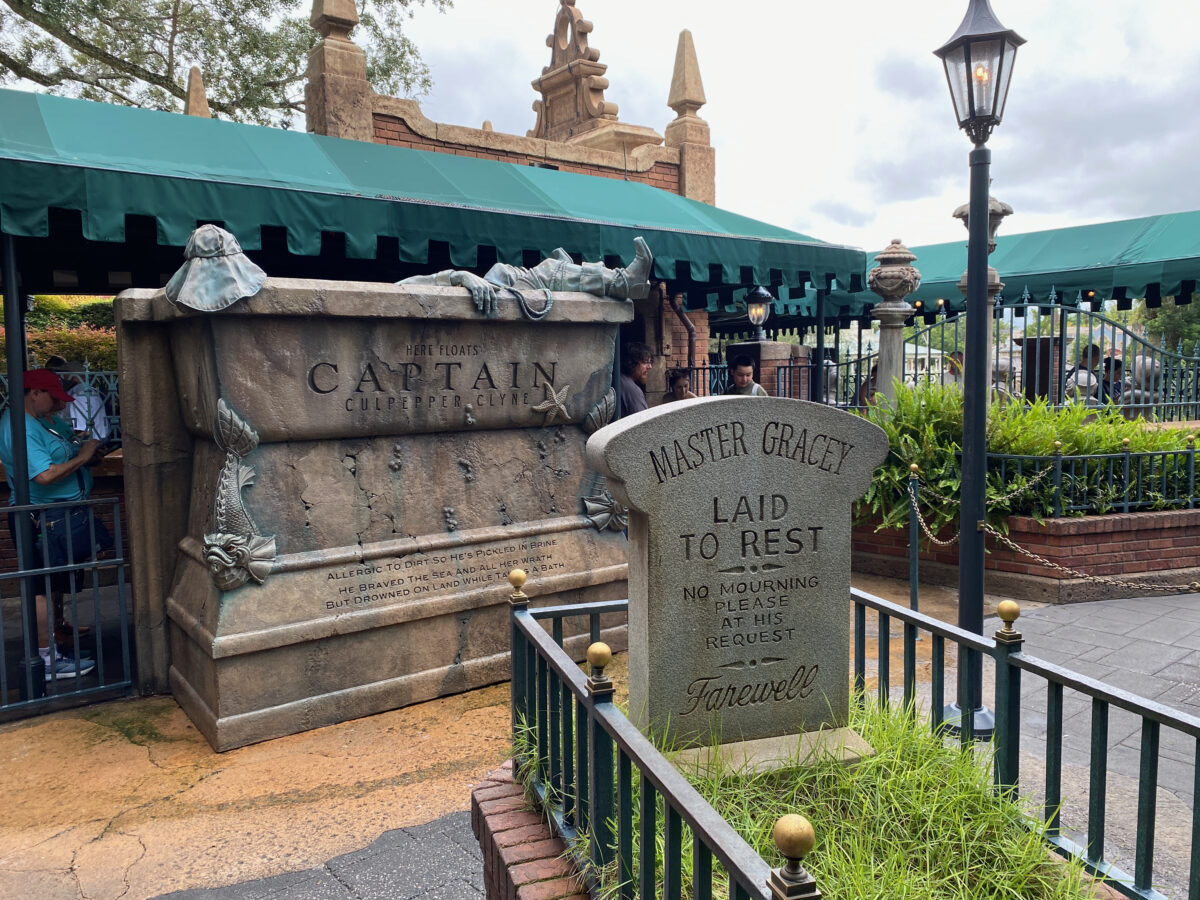
The “999 happy haunts” tagline is good marketing. The actual mechanics behind the attraction are considerably more complex: Pepper’s Ghost illusions — a Victorian-era parlor technique using precisely angled glass — projection mapping, fiber optics, audio-animatronics, scrim lighting, and black light painting all operate in the same physical space at once. Many of these systems date to the original 1969 opening and are still running.
The musty aged-house smell throughout the attraction is a deliberate Smellitzer blend of candle wax and aged wood, designed to support the illusion of a genuinely old structure. Every sense you have is being directed by the attraction’s design from the moment you enter the queue.
There is a holding area for guests who need to be removed from the park — and you’ll never see it happen.
Disney handles tens of thousands of guests daily. When serious incidents occur — fights, theft, disorderly conduct — they’re managed quietly, off the main stage, in a secured area beneath Magic Kingdom. Local law enforcement gets involved if needed, but the process is invisible to the other 50,000 people in the park that day.
The show continues for everyone else because the entire operation is designed to keep it that way. You will never see flashing lights or a visible incident on Main Street. That’s not luck — it’s infrastructure.
The Tree of Life is built on an oil rig.

The 145-foot centerpiece of Animal Kingdom is built on the structural skeleton of a retired offshore oil platform. Engineers needed a frame strong enough to withstand Florida storms and support the weight of over 300,000 artificial leaves. An oil platform — already designed to flex under high wind loads and handle enormous structural stress — was the right answer.
Over that industrial frame, Imagineers carved more than 325 animal figures into the trunk, each morphing seamlessly into the next. An elephant’s trunk becomes a crocodile’s tail becomes a bird’s wing. Walk the Discovery Island trails and get close enough to actually trace the transitions. It’s the clearest physical example of what Disney Imagineering does at its best: turn industrial infrastructure into art.
Article Continues Below
The Invisible Systems Running Everything
There’s a Mickey-shaped solar farm you can only see from the sky.
A few miles from EPCOT, a 22-acre solar installation arranged in the shape of Mickey Mouse’s head — three circles, unmistakable from above — generates enough power on a sunny day to run two theme parks. It’s made up of over 48,000 panels. Disney also built a second, larger facility nearby producing 50 megawatts of clean energy, enough to power roughly a third of the entire resort.
Walt originally envisioned EPCOT as a genuinely self-sustaining Experimental Prototype Community of Tomorrow. The urban community concept evolved into something different, but the innovation infrastructure has continued. Mickey is literally running on sunshine.
EPCOT’s nighttime show technology is mostly underwater.
What you see during an EPCOT nighttime show — the fountains, lasers, projections, fireworks — is largely generated by systems operating beneath the surface of World Showcase Lagoon. Cables, control platforms, and operational infrastructure sit below the waterline. Engineers built all of it while working in scuba gear. They didn’t drain the lagoon.
When you stand at the railing watching the show, you’re looking at the surface of one of the most technically complex live entertainment systems anywhere in the world.
Disney has a real-time command center managing your experience like a resource.
Behind the scenes, Disney operates a monitoring center with live digital maps showing crowd density, weather, ride status, and guest movement patterns across the entire property. When a section of a park starts to feel congested, the response is immediate and invisible: additional food carts appear, street performers materialize, characters show up nearby. Crowd pressure gets redirected before guests feel it building.
The experience feels organic because the management is completely hidden. Someone is actively working to make sure your day flows well, and you will never see them doing it.
Disney is actively managing your sense of time — and it works on almost everyone.
The lighting, music tempo, walkway widths, and scent patterns all shift throughout the day to subtly adjust your internal clock. Golden-toned afternoon light makes everything feel warmer. The slower evening audio tempo encourages lingering. The smell of churros and popcorn at 7pm triggers comfort and nostalgia at the precise moment people would otherwise start thinking about heading home.
By the time you check your phone and realize it’s 9pm, you’ve been walking for twelve hours and your brain genuinely believes it’s been five. This is the result of deliberate psychological design informed by research into human perception and emotional response. It is not accidental.
Spaceship Earth manages its own rainfall.

Every one of the geodesic sphere’s 11,324 triangular panels is designed to channel rainwater in a specific direction, feeding into hidden gutters that route directly into the park’s lagoon. In a Florida downpour, not a single streak of rain runs down the exterior surface.
It stays pristine and gleaming in conditions that would visibly streak any conventional surface. The engineering is quiet and completely invisible to guests — which makes it a perfect example of how Disney resolves every element of a design, including ones nobody would ever consciously notice.
Article Continues Below
One More Thing Worth Knowing
You can bring your own food into the parks — and Disney has always allowed it.
Disney’s official policy allows outside food and non-alcoholic drinks in all parks, as long as nothing is in glass containers and nothing requires heating. You can pack full meals. Walt’s original intent was for families to feel welcomed, not squeezed at every turn.
Quick-service restaurants will also give you free cups of ice water if you ask. Combine that with your own snacks and a refillable bottle, and you’ve built yourself a meaningful budget relief valve on a trip that can add up quickly.
Which of these landed hardest for you? The oil rig inside the Tree of Life, the colonial sewage strip you’ve walked over without knowing it, or the command center quietly making sure your day runs smoothly? Let me know in the comments — and if you know a Disney detail that belongs on this list, share it. The best ones end up in future articles.
Planning your trip? Check Undercover Tourist for authorized Disney tickets before you book direct — it’s where I always start, and it’s saved me real money over the years.