

A few weeks ago I got my hands on a 1998 VHS documentary about the making of Disney’s Animal Kingdom at a flea market. Not a Disney+ retrospective. Not a press release dressed up as a documentary. An actual VHS tape from the year the park opened, back when behind-the-scenes footage existed purely to document something remarkable rather than market it.
I’ve been to Animal Kingdom more times than I can count. I thought I knew the park. This tape reminded me I didn’t.
Then I found it on Youtube through one of my favourite channels: RetroWDW.
Here’s what stood out — and what I think most guests, even the obsessive ones, have never heard.
The whole thing started with a tiger walking into a boardroom. That’s not a metaphor. During the planning stages, Disney executives were genuinely debating whether being near animals was a compelling enough experience to justify building an entire theme park around. Someone solved the argument by bringing a 400-pound Bengal tiger into the meeting room and letting it walk slowly around the table. The executives were convinced. That moment — primal, wordless, impossible to manufacture — became the emotional target that every design decision afterward was trying to recreate at scale.
What’s interesting is that the instinct behind Animal Kingdom goes back further than 1990, when Michael Eisner and the Imagineers formally started brainstorming. Before Disneyland opened, Walt Disney had actually considered using live animals for the original Jungle Cruise. He chose animatronics so every guest would see the same show, but the underlying desire to bring real animals to the public never left the company’s DNA. Walt may have put it best himself: “I only hope we never lose sight of one thing — that it was all started by a mouse.” Animal Kingdom was, in a way, that mouse finally roaring.
Article Continues Below
Before the First Brick Was Laid
Before a single blueprint was drawn, the design team packed up and flew to Africa. Every Imagineer kept a personal diary, and a lot of those stories found their way directly into Kilimanjaro Safaris. They immersed themselves in everything — the look, the feel, the story they wanted to recreate. On the tape you can hear them marveling at the small details. The way elephants really wiggle their ears every time they come up out of the water. A watering hole so perfectly round it looked almost whitewashed, like a cup. These weren’t just observations. They were source material.
The trip’s defining moment happened in Kenya when word spread over car radios that a leopard had been spotted in a tree. Fifty vehicles converged into a traffic jam beneath it, everyone desperate for a glimpse of the same animal. The designers looked at each other and knew — that spontaneous, collective excitement was exactly what they were building toward.
Back home, the work accelerated fast. By April 1992 the design team had their primary park layout in place. Thousands of drawings, models, and pictures were produced. When the first major presentation went to Disney executives, they were genuinely amazed — and with only minor changes, the initial layout was approved and locked in. Animal Kingdom suddenly became, as the documentary puts it, “real and urgent.” Secondary design teams were dispatched to Africa and Asia to research buildings and vegetation. The whole machine was moving.
Building a World, Not a Theme Park
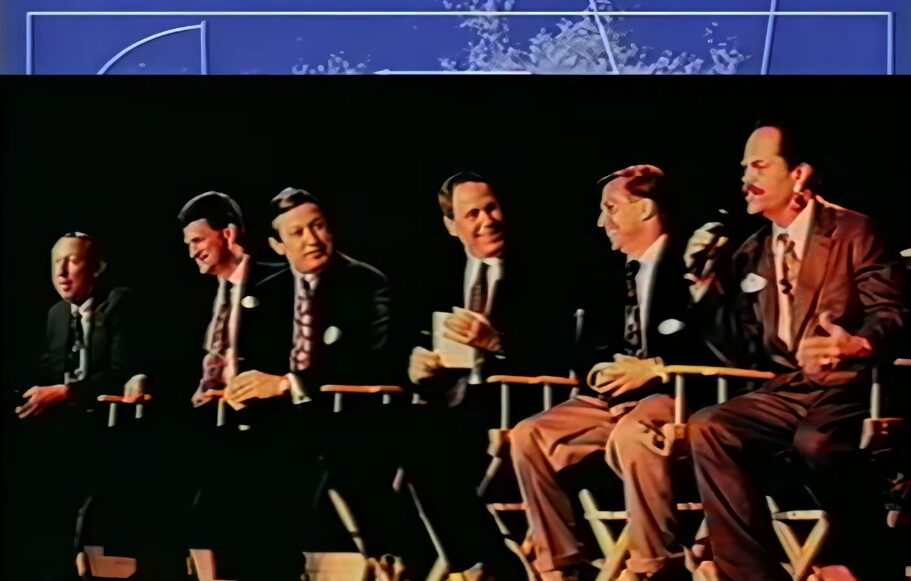
The construction numbers are staggering even by Disney standards. 26,000 workers. Four million cubic yards of earth moved to sculpt the park. 60 miles of underground facilities laid beneath it. But the detail that always stops people is this: 500 skilled workers were hired exclusively to build rocks. Every boulder, cliff face, and outcropping you see in the park is hand-crafted. When you’re riding Kilimanjaro Safaris or walking through Asia, you’re surrounded by the work of hundreds of artisans whose only job was making concrete look like it had been there for centuries.
The Tree of Life had its own engineering problem. The initial concept used a dome structure, but it didn’t hold up. The solution they landed on borrowed technology from offshore oil well platforms — a base capable of supporting massive weight under serious environmental stress. The design used four sequentially sized branches connected in random patterns, a structure that was ingenious precisely because it looked chaotic. The 400-plus animal carvings covering the surface were built as a digital model, cut into small cubes, fabricated in eight-by-eight sections offsite, and flown to the site by helicopter for assembly. The finished tree stands 140 feet tall, has over 100,000 individual leaves, and can withstand winds up to 74 miles per hour. Jane Goodall visited during construction and asked if there was a chimpanzee on the tree. There wasn’t, so the sculptors added David Greybeard — her most famous research subject — near the entrance in her honor. He’s still there.
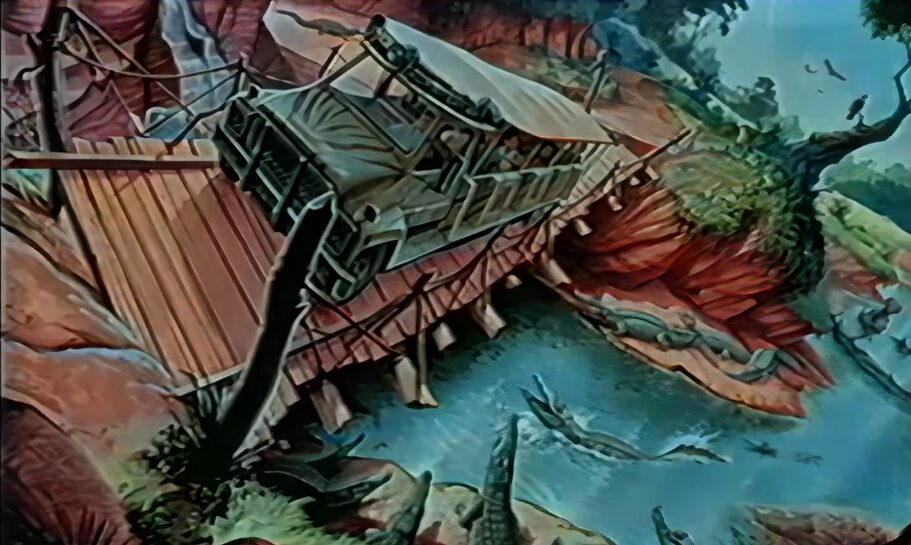
The Kilimanjaro Safaris attraction covers 100 acres and was designed to hold 100 animals across an upland forest and two savannas. One of the core design principles was concealing every barrier between guests and animals. At Gorilla Falls, the documentary notes, guests feel there is nothing between them and a troop of gorillas except a grassy slope and some bamboo. That feeling is entirely engineered. The bumpy road guests ride through the safari is another piece of deliberate deception — a seven-inch cement pathway built with engineered ruts and potholes, then covered with dirt, with planters placed in the road so grass would grow between the tire tracks. The rough ride isn’t wear and tear. It was designed that way from opening day.
The DINOSAUR attraction — called Countdown to Extinction when the park opened — features the largest audio-animatronics ever produced at that time. New computerized movement systems were developed specifically to make those enormous figures move in a realistic way. And the Discovery River boats were artificially aged before anyone ever rode them — bug splats, textured mud, rust, all applied during construction. The philosophy running through every corner of Animal Kingdom is that the story should feel like it started long before you arrived.
On the animal side, Disney committed from the start to two firm rules: animals would only come from pre-captive populations, and no acquisition could add any detriment to wild populations. Some animals were purchased, some loaned, some donated. The holding facilities were budgeted and designed with priority over the attractions themselves — climate-controlled buildings, huge skylights, fresh circulating air. The elephant barn walls were built to withstand over 10,000 pounds of vertical stress, which bulls are capable of inflicting with just their heads. The giraffe barn has hinged doors they can poke their heads through. Three hundred animal care specialists and veterinarians work seven days a week. Every morning vets arrive before dawn to decide which animals go on stage. The park feeds 1,500 animals roughly a ton and a half of food daily — produce, grain, hay, and meat.
Article Continues Below
The landscaping budget was one of the largest single line items in the whole project. Four million plants, from mature trees down to individual grass shoots, guided by three principles: guest comfort, park screening, and putting the right environment around the right attraction. The 600-acre site was chosen specifically because it was high, dry, and already had large stands of native oaks that could be preserved and worked into the design.
The last thing I keep coming back to from this tape is something easy to walk right past. Every other Disney park funnels you through a merchandise corridor at the entrance. Animal Kingdom’s Oasis — the entry area before Discovery Island — deliberately removed that. No gift shop gauntlet. Just space to slow down, breathe, and let the environment arrive before your day starts. That was a conscious philosophical decision, and nearly 30 years later, it’s one the park still gets right.
I have more sources to dig through on this one. There’s a lot more story here than a single tape can hold.